Showing posts with label bishops. Show all posts

Tuesday, July 21, 2026

Move over Bishop Espaillat of NYC. We have a new youngest bishop in the USA.

Move over Bishop Joseph Espaillat of NYC. We have a new youngest bishop in the USA.

History was made on July 7, 2026, at the Basilica of the National Shrine of the Immaculate Conception in Washington, D.C. Father Robert P. Boxie III, the former Catholic chaplain at Howard University, was consecrated as an auxiliary bishop for the Archdiocese of Washington. At just 45 years old, Bishop Boxie is now America’s youngest active Catholic bishop — and the youngest in the Western Hemisphere.

This milestone goes far beyond age. Bishop Boxie is the first member of the Divine Nine (the historic Black Greek-letter organizations) to ascend to the Catholic episcopate. A proud member of Alpha Phi Alpha Fraternity, Inc., he was initiated into the Kappa Theta Chapter at Vanderbilt University in 2000. His elevation represents a powerful bridge between HBCU campus life, Black Greek traditions, and the Catholic Church.


 A Remarkable Journey

Born on September 12, 1980, in Lake Charles, Louisiana, Robert P. Boxie III grew up deeply rooted in the faith community at Sacred Heart of Jesus Catholic Church, a historically Black parish. He graduated from St. Louis Catholic High School in 1998 before heading to Vanderbilt University, where he earned a degree in chemical engineering with a second major in music.

After teaching English in France for a year, he attended Harvard Law School, graduating with a Juris Doctor in 2007. He built an impressive legal career as a federal law clerk for the U.S. District Court in Greenbelt, Maryland, and as an associate at the corporate firm Vinson & Elkins LLP in Washington, D.C. Yet something greater called him. In 2010, he left law behind and entered the seminary.

Boxie studied at the Pontifical North American College and the Gregorian University in Rome, earning a Licentiate of Sacred Theology (STL) in 2017. He was ordained a priest in 2016 and began serving as Catholic chaplain at Howard University in 2020 — a role he held for six transformative years.


 Impact at Howard University (“The Mecca”)

During his tenure at Howard, Bishop Boxie guided the Catholic ministry through the challenges of the pandemic, expanded student programming, organized civil rights pilgrimages, and championed the 2023 opening of the Sister Thea Bowman Catholic Student Center — the first dedicated space for Catholic students at the historic HBCU in decades.

In his message to the Howard community after his appointment, he shared: “You made your chaplain a bishop.” That sentiment captures the pride and inspiration rippling through HBCU networks and Black Catholic communities nationwide.


 A New Chapter in Leadership

Appointed by Pope Leo XIV (the first American pope) on May 1, 2026, Bishop Boxie succeeds Auxiliary Bishop Roy E. Campbell Jr. and becomes the first new African American Catholic bishop in nearly a decade. In his new role as vicar for cultural communities and synodality, he will focus on cultural diversity, youth and young adult ministry, ecumenical relations, interfaith dialogue, and the revitalization of Black Catholic parishes in the Archdiocese of Washington.

His consecration was led by Cardinal Robert McElroy, with co-consecrators Cardinal Wilton Gregory and Bishop Mark Brennan. The ceremony drew leaders, students, parishioners, and supporters from across the country — a powerful testament to the hope and representation his appointment brings.


 Why This Matters

In an era when many young people question whether the Church truly sees them, Bishop Boxie stands as living proof that faith, intellect, service, and cultural identity can converge at the highest levels of leadership. A former engineer, lawyer, chaplain, and Divine Nine member — now a bishop — his story shatters stereotypes and opens doors.

As he told the congregation: “If you’ve ever thought about a priest as your religious vocation, this is your sign… If you have ever felt discouragement from the church… let this be a moment of hope.”

Congratulations, Bishop Robert P. Boxie III. The Church — and the nation — is watching your next chapter with great anticipation. Your journey reminds us that extraordinary leadership often emerges from unexpected paths, and that the future of the Catholic Church is brighter, more diverse, and more vibrant because of leaders like you. 

Welcome to the episcopate, Bishop. The “Mecca” and the broader Black community are proud.


Source: 


https://www.msn.com/en-us/news/us/all-about-the-howard-chaplain-first-black-divine-nine-member-who-is-now-america-s-youngest-bishop/ar-AA28e1zJ?uxmode=ruby&ocid=edgntpruby&pc=EDGEDB&cvid=6a5daee91f1344a2a8c1cde74dd33cfc&ei=11

Thursday, July 2, 2026

The SSPX and the 2026 Excommunication: A New Chapter in an Old Schism

The SSPX and the 2026 Excommunication: A New Chapter in an Old Schism

The Society of Saint Pius X (SSPX), a traditionalist Catholic priestly fraternity founded in 1970 by Archbishop Marcel Lefebvre, has long stood at the center of controversy within the Roman Catholic Church. On July 2, 2026, the Vatican formally declared the SSPX schismatic and imposed excommunication on its clergy and adherents who formally support the group. This followed the SSPX's consecration of four new bishops on July 1 without papal mandate, an act echoing the 1988 crisis but carrying broader canonical consequences.


 Background: From Foundation to the 1988 Crisis

Archbishop Lefebvre established the SSPX in Écône, Switzerland, to preserve the pre-Vatican II liturgical traditions, particularly the Traditional Latin Mass, amid what he saw as modernist influences following the Second Vatican Council (1962–1965). The society faced suppression in 1975, but tensions peaked in 1988 when Lefebvre, against explicit orders from Pope John Paul II, consecrated four bishops (Bernard Fellay, Bernard Tissier de Mallerais, Richard Williamson, and Alfonso de Galarreta) without papal approval.

This act triggered automatic (latae sententiae) excommunication for those directly involved under Canon Law, as it was deemed a schismatic rejection of papal primacy. Pope John Paul II's apostolic letter Ecclesia Dei condemned the move and warned that formal adherence to the schism incurred excommunication. Lefebvre and the bishops disputed the validity of the penalties, arguing they acted out of necessity to safeguard Tradition.

In 2009, Pope Benedict XVI lifted the excommunications of the four surviving bishops as a gesture of outreach. However, the SSPX as an organization remained without canonical status, and its priests' sacraments (especially confessions and marriages) operated in a gray area. Popes Francis and subsequent leaders granted limited faculties for certain sacraments but stopped short of full regularization.


 The 2026 Consecrations and Excommunication

On July 1, 2026—exactly 38 years after the 1988 event—SSPX bishops Alfonso de Galarreta and Bernard Fellay consecrated four new bishops (Pascal Schreiber, Michael Goldade, Michel Poinsinet de Sivry, and Marc Hanappier) at Écône, defying warnings from Pope Leo XIV. Thousands attended the ceremony despite the risks.

The Vatican responded swiftly. On July 2, the Dicastery for the Doctrine of the Faith issued a decree declaring the act schismatic. It confirmed automatic excommunication for the consecrating and newly consecrated bishops. Going further than in 1988, the decree extended this to SSPX priests as schismatics and excommunicated, while warning lay faithful who "formally adhere" to the society that they too incur the penalty. It also declared SSPX-administered confessions and marriages invalid.

This represents a hardening of the Church's position, moving beyond individual penalties to a declaration affecting the entire fraternity.


A Timely Reminder from the Society’s Namesake

Pope St. Pius X, after whom the SSPX is named, offered a powerful teaching on papal authority and holiness in a November 18, 1912 allocution: “Therefore, when we love the Pope, there are no discussions regarding what he orders or demands, or up to what point obedience must go, and in what things he is to be obeyed... we do not set above the authority of the Pope that of other persons, however learned, who dissent from the Pope, who, even though learned, are not holy, because whoever is holy cannot dissent from the Pope.” This excerpt underscores the traditional Catholic emphasis on unity with the Successor of Peter as a mark of true sanctity, a principle that adds poignant irony to the current situation involving a society bearing his name. 


 SSPX's Perspective and Ongoing Divisions

The SSPX maintains it is not schismatic, viewing its actions as necessary resistance to perceived errors in the post-conciliar Church. It rejects the 1975 suppression and both the 1988 and 2026 excommunications as invalid, arguing canon law allows for extraordinary measures in crisis. Supporters see the society as a guardian of doctrinal and liturgical continuity.

Critics, including many within the Church, argue that repeated defiance of papal authority undermines unity and constitutes genuine schism. The 2026 events have renewed debates over Tradition, authority, and the legacy of Vatican II.


 Implications for Catholics

For the faithful, this creates painful choices. The Vatican urges Catholics to avoid SSPX chapels to remain in full communion. Traditionalist communities elsewhere (such as those under the Fraternity of Saint Peter or diocesan Latin Masses) offer alternatives aligned with Rome. The situation highlights deeper tensions in the Church over liturgy, doctrine, and obedience.

As of July 2026, reconciliation seems distant. History shows that bridges can be built, as with the 2009 lifting of excommunications, but repeated episcopal consecrations without mandate have escalated the divide.

The SSPX saga underscores the enduring challenge of balancing fidelity to Tradition with unity under the successor of Peter. Catholics on all sides pray for healing, even as positions harden.


 References


- Wikipedia: Society of Saint Pius X (updated entries on 2026 events).

- EWTN News: Vatican confirms excommunication of SSPX bishops (July 2026).

- Britannica: Society of St. Pius X entry.

- Vatican Press: Decree from the Dicastery for the Doctrine of the Faith (July 2, 2026).

- AP News and other reports on the July 1 consecrations.


Note: This post is for informational purposes and does not constitute canonical advice. Consult your local bishop or reliable Church authorities for personal guidance.

Monday, October 20, 2025

The Power and Authority of Priests to Forgive Sins: A Theological and Historical Examination

The Power and Authority of Priests to Forgive Sins: A Theological and Historical Examination

The authority of priests to forgive or absolve sins remains one of the most debated doctrines within Christian theology, particularly distinguishing Catholic tradition from Protestant perspectives. This discussion was recently brought to the forefront on a social media platform when Reverend Vitus, posting under the handle @Vitus_oss, shared an image on October 19, 2025, depicting a priest laying hands on a penitent with the caption, "Only Catholic priests can forgive your sins here on earth." This assertion provoked a wave of criticism, with respondents labeling it blasphemous and arguing that only Christ possesses the authority to forgive sins. This paper undertakes a comprehensive analysis of the biblical, historical, and theological underpinnings of the Catholic doctrine of priestly absolution, addresses the specific criticisms directed at Reverend Vitus’s post, refutes common Protestant objections, and draws upon scriptural evidence, the mechanism of apostolic succession, the writings of Church Fathers, and the Epistle of James to substantiate the Catholic position.

 Biblical Foundations for Priestly Absolution

The theological basis for the priestly power to forgive sins is rooted in the New Testament, where Jesus Christ explicitly delegates this authority to His apostles. A cornerstone passage is found in John 20:21-23, where, following His resurrection, Jesus appears to the apostles and proclaims, "Peace be with you. As the Father has sent me, so I send you." He then breathes on them, saying, "Receive the Holy Spirit. Whose sins you forgive are forgiven them, and whose sins you retain are retained." This act of breathing evokes the creation of humanity in Genesis 2:7, where God imparts life to Adam, symbolizing a new covenantal authority bestowed upon the Church. The language of forgiveness and retention suggests a judicial role, indicating that the apostles were entrusted with discerning and declaring the state of a person’s soul, a responsibility rooted in Christ’s divine power.

Another critical text is Matthew 16:19, where Jesus tells Peter, "I will give you the keys of the kingdom of heaven; whatever you bind on earth will be bound in heaven, and whatever you loose on earth will be loosed in heaven." This authority to bind and loose, later extended to all the apostles in Matthew 18:18, is interpreted by Catholic theology as encompassing the power to forgive or retain sins. The metaphor of keys signifies a jurisdictional authority, suggesting that the apostles and their successors were granted a divine mandate to govern the spiritual life of the faithful, including the administration of forgiveness.

The Epistle of James provides additional support in James 5:14-16, which states, "Is anyone among you sick? Let them call the elders of the church to pray over them and anoint them with oil in the name of the Lord. And the prayer offered in faith will make the sick person well; the Lord will raise them up. If they have sinned, they will be forgiven. Therefore, confess your sins to one another and pray for one another so that you may be healed." This passage establishes a precedent for confessing sins to Church elders—termed presbyters, from which the term "priest" derives—and links confession with the assurance of forgiveness. The reference to elders praying over the sick and the explicit mention of sin’s forgiveness suggest a ministerial role in mediating divine grace, reinforcing the communal and sacramental dimension of absolution.

 Apostolic Succession and the Transmission of Authority

The Catholic Church asserts that the authority to forgive sins, initially granted to the apostles, has been transmitted through apostolic succession—a continuous lineage of ordained bishops and priests tracing back to the apostolic era. This doctrine is grounded in the early Church’s practice of appointing successors to perpetuate the apostolic mission. Acts 1:20-26 narrates the replacement of Judas Iscariot with Matthias, demonstrating the apostles’ recognition of the need to maintain their number and authority. Similarly, in 2 Timothy 2:2, Paul instructs Timothy, "What you have heard from me through many witnesses entrust to faithful people who will be able to teach others as well," indicating a multi-generational transmission of teaching and authority.

This concept is further elaborated in the writings of the early Church Fathers. St. Ignatius of Antioch, in his Letter to the Smyrnaeans (c. 107 AD), emphasizes the importance of unity with the bishop and presbyters, stating, "Wherever the bishop appears, there let the people be; as wherever Jesus Christ is, there is the Catholic Church." This reflects an early recognition of a hierarchical structure through which Christ’s authority is exercised. St. Clement of Rome, in his First Epistle to the Corinthians (c. 96 AD), reinforces this by noting that the apostles appointed bishops and deacons, establishing a succession to ensure the continuity of their ministry, stating, "Our apostles also knew, through our Lord Jesus Christ, that there would be strife on account of the office of the episcopate."

Through apostolic succession, the power to absolve sins is passed down via the sacrament of Holy Orders, where bishops lay hands on candidates, invoking the Holy Spirit in a manner reminiscent of John 20:22. This sacramental act is understood as a participation in Christ’s eternal priesthood, enabling priests to act in persona Christi (in the person of Christ) when administering absolution. The Council of Trent (Session 14, 1551) formalized this teaching, declaring that the power of the keys was given to the apostles and their lawful successors, ensuring the perpetuation of this ministry within the Church.

 Criticism of Reverend Vitus’s Post and Refutation of Replies

Reverend Vitus’s post, asserting that "Only Catholic priests can forgive your sins here on earth," elicited a strong reaction on the social media platform. One respondent, @ChristDAnswer, labeled the statement "BLASPHEMOUS," arguing, "Jesus is the only intercessor between God and men." Another, @WaltBrown11, echoed this, calling it "a lie from the pit of hell" and asserting that "Christ and Christ ALONE has the power and authority to forgive sin." These criticisms align with a common Protestant view that attributing forgiveness to priests undermines Christ’s unique mediatorship, as articulated in 1 Timothy 2:5, "For there is one God and one mediator between God and mankind, the man Christ Jesus."

To refute these claims, it is crucial to clarify that Catholic theology does not posit priests as independent agents of forgiveness but as instruments of Christ’s authority. The Catechism of the Catholic Church (CCC 1441) affirms that "only God forgives sins," but He has chosen to exercise this power through the ministry of the Church, with priests acting as His representatives. This is not a denial of Christ’s mediatorship but an extension of it, as He delegated this authority to the apostles in John 20:23. The objection that priests usurp Christ’s role misinterprets the ministerial nature of their function, which is derived from and subordinate to His divine power.

Another critic, @farmingandJesus, cited 1 John 1:9 ("If we confess our sins, God is faithful and just to forgive us our sins and to cleanse us from all unrighteousness") to argue that forgiveness is directly accessible through personal confession to God. While personal repentance is undeniably essential, this verse does not preclude the sacramental confession prescribed in James 5:16. The Catholic position holds that both forms of confession—personal prayer and sacramental absolution—complement each other, with the latter providing a tangible assurance of forgiveness through the Church’s ministry, as mediated by the priest.

@Green_Boogers expressed confusion, stating, "I need Christ’s forgiveness, not the priest. That’s a total misunderstanding of the priest’s role." This reflects a misunderstanding that can be addressed by noting that the priest’s role is not to replace Christ but to make His forgiveness present and effective in the sacrament of reconciliation. The formula of absolution, "I absolve you from your sins in the name of the Father, and of the Son, and of the Holy Spirit," underscores that the priest acts by Christ’s authority, not his own. Reverend Vitus’s response to @Green_Boogers, "Authority from Christ himself," aligns with this, citing the delegation in John 20:21-23.

@thaddeusthought offered a nuanced view, stating, "It is God who forgives, through His body the Church, which the priest represents," which partially aligns with Catholic teaching. However, the respondent’s follow-up, "I need Christ’s forgiveness, not the priest," suggests a reluctance to accept the priest’s representative role. This can be refuted by emphasizing that the Church, as the Body of Christ (1 Corinthians 12:27), operates through its ordained ministers to administer the sacraments, including absolution, as an extension of Christ’s salvific work.

 Refutation of Protestant Objections

Protestant theology frequently rejects the priestly power of absolution, citing the priesthood of all believers (1 Peter 2:9) and asserting that direct access to God through Christ negates the need for a human intermediary. The Reformers, notably John Calvin, argued that Christ reserved forgiveness exclusively for Himself, viewing priestly absolution as a medieval corruption of the Gospel. Calvin, in his Institutes of the Christian Religion (Book III, Chapter 4), contends that confession should be made to God alone, dismissing the sacramental role of priests as unbiblical.

However, this objection overlooks the biblical evidence of delegated authority in John 20:23 and the historical practice of the early Church. The priesthood of all believers, which affirms the universal call to holiness, does not negate the existence of a ministerial priesthood, as evidenced by the distinct roles of elders in James 5:14 and the apostles’ authority in the Gospels. The early Church Fathers, such as St. Augustine in Sermons 213.8, affirm that priests forgive sins not by their own power but by Christ’s mandate, stating, "God does what is said through the lips of men." This aligns with the Catholic view that the sacrament of confession is a divinely instituted means of grace, not a human invention.

Another Protestant critique is that the lack of explicit mention of apostolic succession in Scripture undermines its validity. Yet, the principle is implicit in the apostolic practice of appointing successors (e.g., Acts 1:26, Titus 1:5) and is explicitly supported by early Christian writings. St. Irenaeus, in Against Heresies (Book III, Chapter 3, c. 180 AD), traces the succession of bishops from the apostles to combat Gnostic heresy, arguing, "The tradition of the apostles, manifested in the Church throughout the whole world, is preserved by those who are everywhere, thanks to the succession of presbyters." This historical continuity refutes the claim that apostolic succession is a later fabrication.

Protestants may also argue that differences in doctrine among churches claiming apostolic succession (e.g., Roman Catholic, Eastern Orthodox, and Oriental Orthodox) invalidate the concept. However, Catholic theology distinguishes between valid orders and doctrinal orthodoxy, holding that apostolic succession ensures the transmission of sacramental authority, not necessarily uniform belief. The Catechism (CCC 817) acknowledges legitimate diversity within the Church while affirming the unity of its apostolic foundation.

 Theological and Practical Implications

The Catholic doctrine of priestly absolution carries significant theological and practical implications for the life of the Church. Theologically, it underscores the sacramental nature of salvation, wherein God’s grace is mediated through visible signs instituted by Christ. The sacrament of reconciliation provides a structured means of reconciliation, ensuring that forgiveness is administered with accountability, pastoral guidance, and the opportunity for penance. This aligns with the biblical call to confess sins to one another (James 5:16), fostering a communal dimension of sin and forgiveness that personal confession alone may not fully address.

Practically, the sacrament offers psychological and spiritual benefits, providing penitents with a sense of closure and peace through the priest’s absolution. Critics may argue that this imposes an unnecessary burden or fosters guilt, but the Church views it as a gift, offering a concrete encounter with Christ’s mercy. The requirement of confession to a priest, rather than a private act, also serves as a safeguard against self-deception, ensuring that serious sins are addressed with due gravity.

In contrast, Protestant emphasis on direct confession to God, while valid in its focus on personal faith, may lack the communal accountability and sacramental assurance provided by the Catholic system. The Catholic approach, rooted in the apostolic tradition, maintains that Christ’s redemptive work is perpetuated through the Church, with priests serving as His ministers.

 Conclusion

The authority of priests to forgive sins is firmly grounded in Scripture, sustained through apostolic succession, and affirmed by the Church Fathers. The criticisms of Reverend Vitus’s post, while reflecting genuine theological concerns, stem from a misinterpretation of Catholic teaching. Rather than diminishing Christ’s role, the priestly ministry of absolution extends His redemptive work, making it accessible to all through the Church He established. This doctrine, though contested, remains a cornerstone of Catholic identity, offering a rich tapestry of biblical, historical, and sacramental insights that continue to shape Christian practice.


 Sources

- The Holy Bible, New American Bible (NABRE), John 20:21-23, Matthew 16:19, Matthew 18:18, James 5:14-16, 1 John 1:9, 1 Timothy 2:5, 1 Peter 2:9, Acts 1:20-26, 2 Timothy 2:2, Titus 1:5, 1 Corinthians 12:27, Genesis 2:7.
- Catechism of the Catholic Church (CCC), 1441, 817.
- Council of Trent, Session 14, 1551.
- St. Ignatius of Antioch, Letter to the Smyrnaeans, c. 107 AD.
- St. Clement of Rome, First Epistle to the Corinthians, c. 96 AD.
- St. Augustine, Sermons 213.8, c. 5th century.
- St. Irenaeus, Against Heresies, Book III, Chapter 3, c. 180 AD.
- John Calvin, Institutes of the Christian Religion, Book III, Chapter 4, 1536.


Wednesday, July 16, 2025

The Need for Bishops to Imprimatur/Nihil Obstat Catholic Content: Blogs, websites, Influencers, Social Media

The Need for Catholic Bishops to Monitor and Regulate Catholic Blogs, Websites and Social Media Content

Back in 2016, I wrote a blog post regarding the need for bishops to monitor, vet, and regulate Catholic blogs (see: Sacerdotus: Bishops Need To Monitor Blogs). A lot has changed since then. Today we have "influencers" who use newer platforms and technology such as TikTok, Instagram, and livestreaming to post content.  

In an era where digital platforms dominate communication, the Catholic Church faces a significant challenge: the proliferation of unvetted content by laypeople, priests, and self-proclaimed influencers claiming to represent Catholic teaching. Social media platforms like Facebook, Instagram, TikTok, X, and various blogs have become spaces where individuals, some with large followings, present themselves as authoritative voices on the Catechism, the Bible, Church teachings, and liturgy. While many of these voices aim to evangelize, others spread misinformation, personal biases, or even heretical ideas, causing confusion among Catholics and non-Catholics alike.

This unchecked digital content fosters division within the Church, creates factions, and, in some cases, leads to scandal that harms the Church’s credibility. To address this growing issue, Catholic bishops, as the chief teachers and liturgists of their dioceses, must take an active role in monitoring and regulating Catholic content online. This blog post argues for the establishment of a structured system—modeled on the traditional nihil obstat and imprimatur—to certify and vet digital content, ensuring it aligns with authentic Catholic teaching and prevents the spread of error, bias, and scandal. This is a tweet (as it was called then) from 2016 where I mentioned the USCCB suggesting the bishops do more to regulate Catholic blogs:


Pope Benedict XVI's Call to Evangelize the "Digital Continent:

Pope Benedict XVI viewed social media as a powerful tool for evangelization, describing it as a "digital continent" that offers new opportunities to share the Gospel. He emphasized that social networks are not just tools but environments to be inhabited, where Christians should engage authentically to foster dialogue, build relationships, and proclaim faith. In his 2013 message for the 47th World Communications Day, titled "Social Networks: Portals of Truth and Faith; New Spaces for Evangelization," he highlighted that social media can create a "new agora" for sharing ideas and fostering unity, particularly for isolated Christian communities. He encouraged Christians, especially young people, to be "digital witnesses" rather than influencers, sharing faith through authentic, respectful communication rooted in Gospel values.[](https://www.vaticannews.va/en/vatican-city/news/2023-01/pope-emeritus-benedict-xvi-alessandro-gisotti-faith-digital-age.html)[](https://www.vatican.va/content/benedict-xvi/en/messages/communications/documents/hf_ben-xvi_mes_20130124_47th-world-communications-day.html) He also stressed the importance of dialogue and reasoned debate, noting in 2011 that the internet requires a Christian presence that is "honest and open, responsible and respectful of others." He saw social media as a space for catechesis, prayer, and charity, urging priests to use digital tools to help people sense God’s presence. However, he cautioned against pitfalls like self-indulgence or constructing false identities online.[](https://www.tandfonline.com/doi/full/10.1080/23753234.2022.2111974)[](https://www.catholicculture.org/news/headlines/index.cfm?storyid=5243)[](https://www.medjugorjemiracles.com/2011/01/pope-benedict-xvi-encourages-us-social-media-and-internet-users/) Benedict XVI led by example, launching the @Pontifex Twitter account on December 12, 2012, with his first tweet: "Dear friends, I am pleased to get in touch with you through Twitter. Thank you for your generous response. I bless all of you from my heart." This marked a historic step in embracing digital communication for evangelization.[](https://x.com/VaticanNews/status/1610138887409618944)[](https://www.vaticannews.va/en/pope/news/2025-05/pope-leo-xiv-inherits-papal-social-media-accounts.html)[](https://www.vaticannews.va/en/vatican-city/news/2023-01/pope-emeritus-benedict-xvi-alessandro-gisotti-faith-digital-age.html) The Problem: Unvetted Catholic Content and Its Consequences The rise of social media has democratized content creation, allowing anyone with an internet connection to share their views on Catholic doctrine, liturgy, and Church governance. While this has enabled creative evangelization, it has also led to the spread of misinformation and division. Several prominent Catholic influencers, bloggers, and priests have been criticized for content that misrepresents Church teaching or promotes personal agendas. Below are examples of problematic content from individuals and platforms mentioned in the query, illustrating the scope of the issue: 1. Fr. David Michael Moses: A young priest with a significant following on platforms like Instagram and TikTok, Fr. Moses has garnered millions of views for his humorous and heartfelt videos. However, he faced criticism for a video titled “What Protestants Get WRONG about Mary,” which some argued oversimplified or misrepresented Catholic Mariology, potentially alienating ecumenical dialogue partners. While Fr. Moses’ intent is evangelistic, his content occasionally lacks the theological nuance required to accurately convey Church teaching, which can confuse viewers unfamiliar with Catholic doctrine.[](https://religionnews.com/2025/02/12/hes-a-young-millennial-catholic-priest-of-course-hes-a-social-media-influencer/)[](https://catholicreview.org/priest-influencer-on-evangelizing-through-humor-social-media-pitfalls-and-advice-to-gen-z/) 2. Taylor Marshall: A prominent Catholic YouTuber and author, Marshall frequently critiques Pope Francis, Vatican II, and modern liturgical practices, often promoting a traditionalist and right-wing political agenda. His content, including books and videos, has been accused of misrepresenting Catholic teaching on the liturgy and fostering a narrative that questions the legitimacy of post-Vatican II reforms. Marshall’s rhetoric sometimes veers into polarizing territory, creating a faction of Catholics who view the modern Church with suspicion, thus sowing division. (see:
Sacerdotus: Critiquing Taylor R. Marshall’s Catholic Content: Misalignments with Authentic Catholic TeachingSacerdotus: Taylor Marshall Behind Amazon 'Pachamama' Carvings VandalismSacerdotus: Racism from 'Mundabor,' Taylor Marshall & So-called 'Traditionalists' against Africans)
  3. Rorate Caeli: This traditionalist blog has been criticized for spreading misinformation about liturgical reforms, particularly regarding the Traditional Latin Mass (TLM). For instance, in 2025, Rorate Caeli published a draft liturgical policy from Bishop Michael Martin of Charlotte, which sparked controversy by alleging a diocesan ban on altar rails and kneelers. The blog’s selective reporting and framing often fuel resistance to legitimate Church authority and contribute to liturgical factionalism. He recently mocked St. Paul VI, claiming the pontiff has no cultus and that no one cared for him. His disrespect for popes and even saints shows the spiritual disease eating at his soul from within. [](https://www.pillarcatholic.com/p/sources-charlotte-bishop-shelves)[](https://www.ncregister.com/news/bishop-michael-martin-8-things-to-know)

4. TheFrancoTv: This platform has erroneously referred to the pope as the “vicar of God,” a theologically inaccurate term that misrepresents the pope’s role as the Vicar of Christ and leads to Modalism. Such errors can confuse viewers about the nature of papal authority and lead to misunderstandings about Catholic ecclesiology a Christology. (see: Sacerdotus: Is the Pope the Vicar of God? Why This Claim Is Heretical and Not Catholic Teaching) 5. Michael Lofton: A Catholic apologist and host of Reason and Theology, Lofton has been criticized for using the term “Novus Ordo” to describe the post-Vatican II Mass. This term, not officially recognized by the Church, is often employed by traditionalists to disparage the Ordinary Form of the Mass, potentially undermining the legitimacy of the Church’s liturgical reforms. Some have described him as obstinate and arrogant, refused to accept correction when presented. He had a spat with Cardinal Zen some time ago ((4) Joseph Zen on X: "I am accused of not following the “Hermenentics of continuity” when criticizing the “Fiducia supplicans”!?         I must confess that I have often wasted my time following the program “Reason and Theology” of Michael Lofton,…… https://t.co/uN9h2E6Qip" / X). (see: Sacerdotus: Michael Lofton's Gaffe: Unreasonable & Non-Theological Use of "Novus Ordo")
6. OnePeterFive: This outlet, founded by Steve Skojec, who is now an atheist/agnostic (see: Fighting the Church may lead you right out of the Church – Catholic World Report), has been accused of posting false or misleading information about the liturgy, particularly in its opposition to restrictions on the Extraordinary Form. For example, a 2024 article speculated about a Vatican crackdown on the Extraordinary Form, amplifying rumors without sufficient evidence, which fueled division among traditionalist Catholics.[](https://onepeterfive.com/banning-the-tlm-again-latest-developments/)
7. Deacon Nick Donnelly: Known for his outspoken social media presence, Deacon Donnelly has been criticized for posting content that defames Pope Francis and spreads misinformation about liturgical practices. His rhetoric often aligns with traditionalist factions, contributing to a polarized Catholic community. He was reprimanded by his bishop and was forced to shut down his blog (see: English bishop silences conservative deacon's blog | News Headlines | Catholic Culture). Despite this, he continues to post content contrary to the Catholic faith and attacks against Pope Francis, completely disobeying his bishop. 8. Michael Lewis and Where Peter Is: These platforms have been accused of promoting liberal interpretations of Church teaching that deviate from orthodoxy. Their content sometimes emphasizes progressive views on issues like gender, sexuality, and Vatican II, which can confuse Catholics seeking clear guidance aligned with the Magisterium. (see: Sacerdotus: Review of Mike Lewis and Where Peter Is: Slander, Rudeness, and a Shallow Grasp of Catholicism)
9. Father James Martin, SJ: A Jesuit priest who is progressive in his views and claims to want to build bridges between the LGBTQIA community and the Catholic community, in particular LGBTQIA Catholics who often feel marginalized in the Church. Despite this noble attempt at good shepherding, so to speak, his tactic often involves watering down the faith to appease leftists and the gay agenda. Martin has even called for the Catechism to be amended in regards to the section on Homosexuality. Instead of calling homosexuals to a life of chastity and celibacy, depending on how strong their attraction is, Martin encourages their lifestyles and behaviors.
10. Other Influencers: Beyond those named, other Catholic influencers have been criticized for speaking ill of Vatican II or the charismatic movement, both in English and Spanish-speaking nations. For example, some traditionalist bloggers denounce charismatic practices as “un-Catholic,” despite their approval by the Church, while others misrepresent Vatican II as a break from tradition rather than a development of doctrine. These narratives create factions within the Church, pitting traditionalists against progressives or charismatics. The Scandals of “Catholic Inc.” and Their Impact The dangers of unvetted Catholic content extend beyond theological errors to moral scandals that damage the Church’s reputation. Recent allegations against influencers associated with “Catholic Inc.,” a term used to describe the network of Catholic media personalities and platforms, highlight this issue. For instance: - Voice of Reason and Wretched Saint: These influencers have faced accusations of sexual misconduct, including inappropriate behavior via direct messages (DMs) and sexting. There is even an accusation of pedophilia, which remains to be confirmed but is under investigation by authorities, including Bishop Artur ((4) ♰ Roark the Integralist🇻🇦☦️ on X: "Bishop Artur is acting, VoR is going to be properly investigated and is, as of today, currently restricted from activity or involvement in Eparchy of Phoenix facilities and from Eparchy sponsored events." / X). Such scandals not only discredit the individuals involved but also harm the Church’s credibility, as these figures are often perceived as representatives of Catholic values. The lack of oversight allows such behavior to go unchecked until public exposure, causing significant harm to the faithful and the Church’s mission.[](https://www.bishop-accountability.org/news/list/) (Sacerdotus: Alex 'Voice of Reason' Jurado's Statement Amid Controversy)
These scandals underscore the need for accountability. When influencers operate without oversight, their personal failings can be amplified by their platforms, leading to widespread disillusionment among Catholics and skepticism from non-Catholics. Many times, the fame and attention can get to one's head, leading to pride, narcissism, and other antisocial behaviors that can lead to sinful and/or criminal behavior. The Role of Bishops as Guardians of the Faith Catholic bishops, as successors of the apostles, are the primary teachers of the faith and liturgists in their dioceses. According to the Second Vatican Council’s Lumen Gentium, bishops are tasked with “fostering a dynamic, open and missionary communion” and ensuring the faithful receive authentic teaching (LG 31). The Code of Canon Law further emphasizes their role in overseeing catechesis and liturgical practices (Can. 386, 838). In the digital age, this responsibility extends to online platforms, where misinformation and scandal can spread rapidly. The Church has long recognized the need to regulate published content through mechanisms like the nihil obstat (“nothing obstructs”) and imprimatur (“let it be printed”). These certifications, issued by bishops or their delegates, ensure that books and other materials are free from doctrinal error. However, no equivalent system exists for digital content, leaving a gap that allows misinformation and scandal to flourish. Without oversight, self-appointed influencers can claim magisterial authority, leading to confusion and division. The Consequences of Unregulated Content Unregulated Catholic content has several detrimental effects: 1. Confusion Among the Faithful: Misinformation about the Catechism, Church teachings, liturgy, or papal authority can lead Catholics to misunderstand core teachings, weakening their faith or leading them to adopt heterodox views. 2. Division and Factionalism: Content that promotes traditionalist, progressive, or other agendas creates “cliques” within the Church, undermining the unity called for by St. Paul in Ephesians 4:3 to “keep the unity of the Spirit in the bond of peace.”[](https://onepeterfive.com/banning-the-tlm-again-latest-developments/) 3. Harm to Evangelization: Non-Catholics encountering erroneous content may form negative perceptions of the Church, hindering evangelistic efforts. 4. Scandal and Loss of Credibility: Scandals like those involving Voice of Reason and Wretched Saint damage the Church’s moral authority, making it harder to proclaim the Gospel effectively. A Proposed Solution: A Digital Certification Program To address these challenges, bishops should establish a digital certification program to regulate Catholic content online. This program would ensure that bloggers, influencers, and clergy produce content aligned with Church teaching, free from error, bias, politics, or scandal. Below are key components of such a program: 1. Digital Missionary Courses: - Bishops could develop courses that can be taken online or in person, covering Catholic doctrine, biblical studies, liturgy, ecclesiology, apologetics, moral theology, human development, industrial psychology, and digital evangelization ethics. These courses would be mandatory for anyone seeking to produce Catholic content on and offline under the Church’s auspices. - Topics could include the Catechism, Vatican II documents, canon law, and guidelines for respectful discourse about the pope and Church hierarchy, the Bible, psychology, and how to engage others professionally, ethics, and philosophy. - Participants would need to pass assessments to demonstrate theological competency and commitment to orthodoxy. 2. Content Vetting Process: - Before posting, content creators would submit their material to a diocesan review board, which would assess it for doctrinal accuracy and alignment with Church teaching. - The board could include theologians, canon lawyers, secular lawyers, philosophers, psychologists and media experts appointed by the bishop. - Content that passes review would receive a digital seal of approval, similar to the nihil obstat and imprimatur. Any revisions to approved content would need to be resubmitted for reapproval. 3. Digital Seal of Approval: - Approved content creators could display a digital seal on their blogs, websites, or social media profiles, indicating that their content has been vetted and approved by the diocese. - This seal would assure viewers that the content is free from error and bias, fostering trust and credibility. 4. Ongoing Oversight: - Certified creators would be subject to periodic reviews to ensure continued adherence to Church teaching. - Bishops could establish a reporting mechanism for viewers to flag problematic content, allowing for swift investigation and, if necessary, revocation of certification. 5. Collaboration with Existing Platforms: - Dioceses could partner with reputable Catholic media outlets, such as EWTN, CTV, the Catholic News Service, or Word on Fire, to promote certified content and train digital missionaries.[](https://www.pewresearch.org/religion/2010/06/11/the-pope-meets-the-press-media-coverage-of-the-clergy-abuse-scandal/)[](https://thetablet.org/influencers-in-christ-catholic-content-creators-use-social-media-to-educate-and-evangelize/) - These partnerships could also provide resources for content creators, such as access to theological experts or digital marketing training. Implementation Challenges and Solutions Implementing a digital certification program would face challenges, including resistance from independent influencers, logistical constraints, and concerns about censorship. However, these can be addressed: - Resistance from Influencers: Some may view oversight as an infringement on free speech. Bishops can counter this by emphasizing that certification is necessary for those claiming to represent Catholic teaching. The Church's teachings and liturgy are the speech of the Catholic Church, not individuals. Non-certified creators could still post due to free will, but without the Church’s official endorsement which will make their content not authorize and therefore possibly full of errors, bias and other problems which will tarnish the content's reputation. - Logistical Constraints: Reviewing content across multiple platforms is resource-intensive. Dioceses could leverage technology, such as AI tools, to flag potentially problematic content for human review, reducing the burden on staff. - Censorship Concerns: To avoid perceptions of censorship, bishops should ensure the vetting process is transparent, with clear criteria based on the Catechism and magisterial documents. They can offer opportunities for the content to be edited and updated for accuracy and orthodoxy. Benefits of a Certification Program A digital certification program would yield significant benefits: 1. Doctrinal Clarity: Certified content would provide Catholics and non-Catholics with reliable, accurate teaching, reducing confusion. This information can be sourced directly from the Church's teachings. 2. Unity in the Church: By discouraging factionalism and polarizing rhetoric, the program would foster communion among the faithful. There will no longer be "traditionalists" or "progressive Catholics" and so forth. 3. Protection Against Scandal: Vetting creators’ backgrounds and content would minimize the risk of scandals like those involving Catholic Inc. influencers. 4. Enhanced Evangelization: Certified content would present a unified, credible voice for the Church, attracting those seeking authentic teaching. Conclusion The digital age offers unprecedented opportunities for evangelization, but it also poses risks when unvetted voices claim to speak for the Catholic Church. The examples of Fr. David Moses, Taylor Marshall, Rorate Caeli, TheFrancoTv, Michael Lofton, OnePeterFive, Deacon Nick Donnelly, Michael Lewis, Where Peter Is, Father James Martin, SJ, and the scandals of Catholic Inc. demonstrate the urgent need for oversight. Bishops, as the Church’s chief teachers and liturgists, are uniquely positioned to address this challenge by establishing a digital certification program modeled on the nihil obstat and imprimatur. By requiring courses, vetting content, and issuing digital seals, bishops can ensure that Catholic content online is accurate, unifying, and free from scandal. This proactive approach will safeguard the Church’s mission, protect the faithful from error, and strengthen the Church’s witness in the digital world.

Thursday, July 10, 2025

Translation of Diana Montagna's 'Leaked Documents' & Summary

Below is a rough translation of the alleged leaked documents journalist Diana Montagna provided on her Substack claiming as evidence of her claims that the majority of Bishops favored the Extraordinary Form of the Mass, leaving Summorum Ponitificum in place and that Pope Francis acted against their wishes and misled the Catholic faithful by stating another outcome of the survey.  

Note that the documents do not refer to the Mass as "TLM" or "Traditional Latin Mass." They use the proper and only name: Extraordinary Form:


Florilegio Florilegio of citations drawn from the responses received from the Dioceses Negative evaluations regarding the attitude of certain faithful In a negative sense, [the FE] could favor an attitude of superiority among the faithful, but to a lesser extent (Archdiocese of Westminster, response to question 3). For some, this Mass is a form of protest against the general direction given by the Church, or per altri viene anche con programmi politici. Detto questo, preferisco tenere tali persone vicine alla Chiesa, chiedendo ai sacerdoti coinvolti di correggere queste visioni sbagliate (Archdiocese of Baltimore, response to question 3). I do not see negative aspects in this use of the FE insofar as it is. Quando ci sono aspetti negativi, essi sono dovuti agli atteggiamenti negativi di coloro che hanno opinioni forti in una direzione o nell'altra, rispetto a questa forma celebrativa. Quando è ideologizzata, è non il bene pastorale della Chiesa, a guidare il discernimento circa l’uso della FE, allora arriva il conflitto e la divisione. Ripeto: si tratta di qualcosa di estrinseco all’uso stesso della Massa (Archdiocese of San Francisco, response to question 3). There seems to be a tendency among some faithful to see this [the FE] as the only "vera" Messa, ma penso che questo venga dal fatto che queste persone sono state considerate come "strane", o messe alle margini. Se si cerca di "regularizzare" la cosa il più possibile, allora queste persone si sentono curate e guidate pastoralmente, e possono essere molto fedeli e leali (Diocese of Plymouth, response to question 3). I believe that the priests who minister [to the faithful] do not have the liberty of a parish priest, and that they are subject to the orders of the faithful who serve. Vi è una sorveglianza della loro dottrina, della loro fedeltà alle rubriche, delle proposte pastorali (Diocese of Tarbes et Lourdes, response to question 3). Some people who support the FE often come with presupposed ideologies. Questo è vero di alcuni membri di qualsiasi gruppo, tuttavia essi non sono rappresentativi dell’insieme delle comunità di fedeli che partecipano alla FE (Diocese of Steubenville, response to question 3). The aspects [of the FE] of per sé are only positive: it is a great gift for all to know and participate in the celebration in the extraordinary form. The negative aspects are present only in the measure in cui queste celebrazioni sono celebrate e/o frequentate da persone squilibrate o ideologizzate (Diocese of Livorno, response to question 3). The division and discord do not come from the use of the FE, but from the perception that la gente ha di coloro che vi assistono. Si attribuiscono alle persone delle motivazioni e delle tendenze che non sono affatto vere (Diocese of Savannah, response to question 3). [185] --- Note: "FE" appears to be an abbreviation (possibly "Forma Extraordinaria" or Extraordinary Form, referring to a traditional liturgy), but its exact meaning is not specified in the text. The translation preserves the context as provided.


Below is the English translation of the provided text:

--- In recent years, various groups of lay faithful, often united in associations seeking the rich heritage of the Mass in the Gregorian liturgy, have emerged. 47. Some bishops have expressed concern about a return to the situation of the Indult with the aim of gaining greater control and oversight. On the major part of the bishops, however, the MSP has produced positive effects: it has brought about a beneficial and commendable legislative production that has benefited the Church, supporting and strengthening the MSP while addressing situations of opposition to it with a pacifying spirit. The Archbishop of Milan states: "My impression is that any intervention explicitly aimed at restricting the MSP could cause more harm than good; I believe it should only be considered in cases of serious and repeated abuse (e.g., solo). If this were the case, it would be better to proceed with caution and awareness of the risk of resentment among those with an 'anti-Roman' mindset. Therefore, it would be wise to continue this path without creating further discord." 48. Others believe that an eventual change by the Holy See, on the other hand, would favor a flourishing of fidelity to the Church, as seen in the example of the Fraternity of Saint Pius X in various schismatic groups; this should force a sincere reflection on the idea that one should not always trust in "a Rome that gives with one hand and takes with the other." Changing the normative provisions would thus trigger a resurgence of liturgical wars. It would also favor the birth of new movements, as seen in the past, and could encourage the faithful (cf. Motu Proprio Ecclesia Dei Afflicta of 1988; MSP of 2007). 49. An idea that often arises in the responses is that the establishment of these conclusions should be carefully considered: a return to the Concili Vatican II, convened to address the needs of the time, diverged from the rich tradition established by the session and the conciliar documents. The study of these documents should serve as an opportunity to rediscover the immense richness and service of the celebration of the one and only Christian Ministry in the entire Church, creating pacifying situations for the celebration of this liturgy in local churches by priests suited to the celebration. 50. Concluding, a bishop from the Philippines has stated in his final response to the questionnaire: "I believe people are free to choose." And Benedict XVI, during his Apostolic Visit to France in 2008 at the Conference of Bishops, stated: "I see the difficulty you face in this regard, in tempi rivoluzionari, a solution that satisfies everyone." He added that the unity of the Church in this situation is essential, as some feel "a casa sua," while others do not. Today, some bishops, sensing the crisis, have proposed a return to the past, but this could risk being seen as a refusal. Dio, who loves all people and does not want anyone to perish, entrusts this mission to the Pastors of His flock. We cannot thank Him enough for the honor and trust He grants us. Let us strive to be ever-faithful servants, reaffirming our commitment against any form of division and exclusion in the Church. In essence, these words should serve as a line of reflection, judgment, and guidance for us today. Rome, 22 February 2021 Feast of the Cathedra of Saint Peter the Apostle [184] ---
Note: "MSP" appears to be an abbreviation (possibly "Motu Proprio Summorum Pontificum"), and "FE" from the previous text might relate to it. The translation preserves the context as provided, with some terms left in their original form where meaning is unclear without additional context.


Below is the English translation of the provided text: --- Comprehensive Judgment 34. The important role of the document is evident, as the Motu Proprio Summorum Pontificum brought today a truly significant, albeit relatively modest, renewal to the life of the Church. The concept of Pope Benedict XVI, over ten years of widespread support among advocates of the reformed liturgy of 1970 and those of the Missale Romanum in its 1962 version, the MSP has successfully affirmed the equal dignity of the two forms of the same Roman Rite, creating a condition favorable to a true liturgical peace, also in view of an eventual unity of the two forms in the future. 35. The reciprocal enrichment and updating of the Missale Romanum of 1962, auspicated by the aforementioned Pope (cf. letter of 7 July 2007) is something that can be achieved only with the application of the same Motu Proprio. Universae Ecclesiae del 30 April 2011, and due to the decree confirmed by Pope Francis on 15 December 2019, which unanimously favored the Fathers members of the Congregation for the Doctrine of the Faith (decree Quo magis, regarding the addition of seven new prefaces, and decree Cum Sanctissima, regarding the insertion of new Saints). 36. The diffusion of the ancient Roman Rite following the MSP is attested to within 20% of the Latin dioceses worldwide, and its application today is certainly more serene and pacifying, even if not everywhere; there are cases of residual discord not resolved. Furthermore, in some dioceses, this state is considered a FE that comes with a certain inappropriate, disturbing, albeit minor per la vita pastorale ordinaria e anche "pericoloso" if not addressed, or at least controlled strictly so that it does not spread, given the possibility of eventual division or abolition. 37. The majority of bishops involved in the questionnaire, who have generously and intelligently applied the MSP, declare at the end of their responses that, in particular, those who have also had the opportunity to form a personal parish, where all sacraments are administered according to the FE and where a stable community celebrates with devotion and pastoral care, have closely collaborated with the bishop in this situation which has been entirely pacifying. 38. Constantly, some bishops note, and this is especially true among young priests, a certain desire to know this ancient Liturgy. The major part of stable groups present nell’orbe cattolico who compose it with devotion and fervor have shown, over time, a certain solemnity of the Liturgy. This has been noted, also a cause of a society excessively noisy and talkative, the recourse to silence in sacred action, the role of liturgical chant, the dignity of celebration: all of which attract non poco. Pope Benedict XVI wrote in the letter to bishops accompanying the MSP, this quest succitata categoria di persone sono i destinatari privilegiati del Suo provvidenmento legislativo, oltre, chiaramente, tutti coloro che da decenni chiedevano la liberalizzazione e la legittimazione nella prassi liturgico-pastorale della venerabile Liturgia latino-gregoriana. [181] --- Note: "MSP" likely refers to Motu Proprio Summorum Pontificum, and "FE" may relate to "Forma Extraordinaria" (Extraordinary Form). The translation preserves the context as provided, with some terms left in their original form where meaning is unclear without additional context.


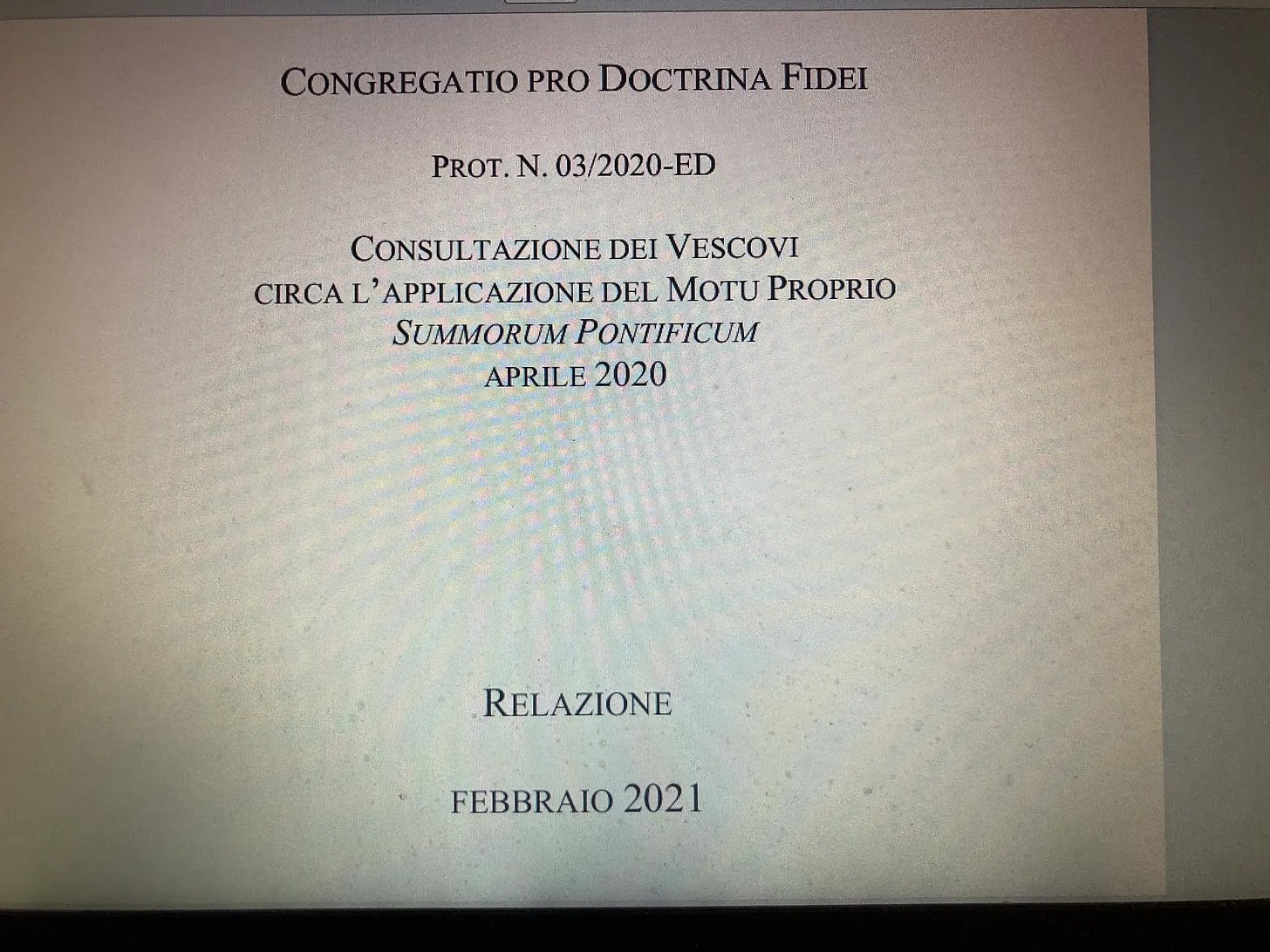
The text in the image is in Italian and translates to: --- CONGREGATIO PRO DOCTRINA FIDEI Prot. N. 03/2020-ED CONSULTATION OF BISHOPS CONCERNING THE APPLICATION OF THE MOTU PROPRIO SUMMORUM PONTIFICUM APRIL 2020 REPORT FEBRUARY 2021 --- This appears to be the cover page of a report prepared by the Congregation for the Doctrine of the Faith regarding the consultation of bishops on the application of the Motu Proprio Summorum Pontificum, dated April 2020, with the report finalized in February 2021.
___________________________________________________________________________________

Below is a summary of each document based on the translated content, followed by an analysis regarding whether they suggest Pope Francis lied or misled the Church with Traditionis Custodes. Summary of Each Document 1. Florilegio (First Document) - Content: This document compiles responses from various dioceses regarding the attitudes of certain faithful toward the Extraordinary Form (FE) of the Mass. It highlights mixed opinions: some see it as a source of pride or protest, others note risks of division or ideological misuse. Positive aspects include pastoral care and fidelity, while negative aspects include potential superiority or conflict among faithful. - Purpose: To gather and present diverse perspectives on the implementation and impact of the FE, reflecting both support and concerns. 2. Giudizio compensivo (Second Document) - Content: This provides a comprehensive judgment on the *Motu Proprio Summorum Pontificum* (MSP). It notes the MSP’s role in affirming the equal dignity of the 1962 and 1970 Missals, fostering liturgical peace, and addressing challenges like schism or discord. It includes bishops’ views on its application, with some favoring its continuation and others cautioning against potential divisions. - Purpose: To evaluate the MSP’s effects over a decade, suggesting a balanced approach to its use while acknowledging both benefits and risks. 3. Relazione (Third Document) - Content: This is a report from the Congregation for the Doctrine of the Faith (CDF) summarizing a 2020 consultation of bishops on the application of *Summorum Pontificum*. It reflects on the document’s impact, noting a 20% adoption rate among Latin dioceses, serene application in some areas, and ongoing tensions or divisions in others. It emphasizes the need for pastoral oversight. - Purpose: To assess the practical implementation of MSP and provide a basis for future decisions based on bishops’ feedback. Analysis: Did Pope Francis Lie or Mislead with Traditionis Custodes? Traditionis Custodes, issued by Pope Francis on July 16, 2021, restricts the use of the Extraordinary Form (1962 Missal) established by Summorum Pontificum (2007), citing concerns about disunity, rejection of Vatican II, and the need to preserve liturgical unity. It requires bishops’ approval for its use and emphasizes the 1970 Missal as the sole expression of the Roman Rite. - Evidence from Documents: - The Florilegio and Giudizio compensivo acknowledge both positive (e.g., pastoral care, liturgical richness) and negative aspects (e.g., division, ideological misuse) of the FE, aligning with concerns later expressed in Traditionis Custodes. The Relazione specifically notes a 20% adoption rate and residual discord, suggesting that the issues of disunity and uneven application were recognized by 2020. - These documents do not universally oppose the FE but highlight challenges that could justify regulatory adjustments, consistent with the CDF’s consultation process leading to Traditionis Custodes. - Assessment of Misleading or Lying: - There is no direct evidence in these documents that Pope Francis lied. The concerns about division and ideological misuse cited in *Traditionis Custodes* are reflected in the bishops’ responses (e.g., Archdiocese of San Francisco noting conflict, Diocese of Savannah mentioning perceived motivations). The *Relazione*’s timing (February 2021) indicates the CDF was aware of these issues before the motu proprio’s issuance, suggesting a deliberate response to documented feedback rather than fabrication. - However, some might argue he misled the Church if they believe he overstated the extent of the problem or ignored the positive aspects (e.g., young priests’ interest, as noted in the Relazione). The documents show a mixed picture, with many bishops supporting the FE’s pacifying effects, which Traditionis Custodes does not fully emphasize. This could be seen as selective framing rather than outright deception. - Conclusion: The documents do not prove Pope Francis lied or misled the Church. They support the existence of the issues he addressed, though his decision to restrict the FE contrasts with the balanced tone of the earlier reports. Any perception of misleading likely stems from differing interpretations of the data rather than intentional falsehood, as the CDF’s consultation process appears to have informed his action. This analysis is based on the provided texts and does not extend beyond their content or the context of Traditionis Custodes as issued.

Tuesday, July 1, 2025

Critical Analysis of Diane Montagna's Article and Claims Regarding Traditionis Custodes

The article by Diane Montagna, published on July 1, 2025, claims that a Vatican report, based on a 2020 survey of bishops conducted by the Congregation for the Doctrine of the Faith (CDF), undermines the rationale for Pope Francis’ 2021 motu proprio *Traditionis Custodes*, which restricted the use of the Extraordinary Form of the Roman Rite (commonly known as the Traditional Latin Mass).

Montagna argues that the survey showed most bishops viewed Pope Benedict XVI’s *Summorum Pontificum* (2007), which liberalized access to the Extraordinary Form, as successful and fostering liturgical peace, thus questioning the stated need for *Traditionis Custodes*. Below, I will address the article’s claims, focusing on the survey of bishops and the question of demand for the Extraordinary Form, and provide a critical refutation using available evidence and reasoning.


Overview of Montagna’s Claims
Montagna’s article asserts: 1. The CDF’s 2020 survey of bishops worldwide showed that the majority supported *Summorum Pontificum* and found it effective in promoting ecclesial peace and liturgical integration.
2. The survey results contradict Pope Francis’ rationale in *Traditionis Custodes*, which claimed the Extraordinary Form was being used to foster division and reject the Ordinary Form of the Roman Rite (post-Vatican II Mass).
3. The Vatican withheld the survey’s findings, particularly the positive assessments of *Summorum Pontificum*, to justify restricting the Extraordinary Form.
4. The article cites specific responses, such as that of Archbishop Allen Vigneron, who praised *Summorum Pontificum* for resolving contention and enriching the Church without threatening the Ordinary Form. Refutation of the Article’s Claims 1. The Survey’s Scope and Interpretation
Montagna’s article suggests that the 2020 survey overwhelmingly supported the continuation of *Summorum Pontificum* and showed no significant demand for restricting the Extraordinary Form. However, this claim oversimplifies the survey’s purpose and findings. The survey, sent by Cardinal Luis Ladaria to bishops in spring 2020, was intended to assess the implementation of *Summorum Pontificum* thirteen years after its promulgation, not to determine whether it should be abrogated or restricted. Questions included whether bishops personally used the 1962 Missal, the influence of the Extraordinary Form on seminaries, and whether it met a “true pastoral need” or was driven by individual priests.[](https://www.catholicnewsagency.com/news/44335/vatican-sends-extraordinary-form-mass-survey-to-worlds-bishops)[](https://adoremus.org/2020/07/vatican-sends-extraordinary-form-mass-survey-to-worlds-bishops/) While Montagna cites positive responses, such as Archbishop Vigneron’s, her article selectively highlights comments that favor the Extraordinary Form. The survey’s full dataset has not been publicly released, so her claim that “the majority of bishops” supported *Summorum Pontificum* without reservation lacks verification. Partial leaks, such as those Montagna published in October 2021, show a range of responses, with some bishops noting positive effects (e.g., attracting younger Catholics) but others expressing concerns about division or the marginalization of the Ordinary Form. For example, Pope Francis’ accompanying letter to *Traditionis Custodes* states that the survey revealed a “situation that preoccupies and saddens me and persuades me of the need to intervene,” suggesting that some responses highlighted issues with the Extraordinary Form’s implementation, such as its use to challenge the legitimacy of the Ordinary Form.[](https://www.lifesitenews.com/news/vatican-reporter-finds-traditionis-custodes-not-based-on-bishops-input-as-pope-francis-claimed/)[](https://www.lifesitenews.com/news/vatican-reporter-finds-traditionis-custodes-not-based-on-bishops-input-as-pope-francis-claimed/) Refutation: Montagna’s claim that the survey uniformly supported *Summorum Pontificum* is misleading due to selective quotation. Without the full report, it’s impossible to confirm her assertion about the “majority” of bishops. Pope Francis’ decision to issue *Traditionis Custodes* was informed by the CDF’s analysis, which likely included concerns about liturgical disunity, even if some bishops praised the Extraordinary Form. The lack of public access to the survey limits the ability to independently verify Montagna’s interpretation.[](https://www.lifesitenews.com/news/vatican-reporter-finds-traditionis-custodes-not-based-on-bishops-input-as-pope-francis-claimed/) 2. Demand for the Extraordinary Form Montagna’s article implies that the Extraordinary Form enjoys widespread and growing demand, particularly among younger Catholics and families, and that suppressing it ignores this pastoral need. She cites the survey’s findings that younger people were drawn to the Church through the Extraordinary Form and that it fostered vocations and family life.[](https://dianemontagna.substack.com/p/exclusive-official-vatican-report) However, the demand for the Extraordinary Form must be contextualized. While it has a dedicated following, the Ordinary Form remains the normative liturgy for the vast majority of Catholics worldwide. A 2020 statement by Joseph Shaw of the International Una Voce Federation noted growth in Extraordinary Form communities but acknowledged that they represent a small fraction of Catholic liturgical practice, with 364 dioceses in 52 countries reporting appreciation for the Extraordinary Form. In contrast, the Ordinary Form is celebrated in thousands of parishes globally, indicating significantly broader usage. Furthermore, a 2023 survey by Catholic Laity and Clergy for Renewal found that most U.S. Catholics attend the Ordinary Form and are either unaware of or neutral toward Vatican II’s liturgical reforms, suggesting that the Ordinary Form meets the pastoral needs of the majority.[](https://threadreaderapp.com/thread/1411669215304634369.html)[](https://whatweneednow.substack.com/p/have-american-catholics-rejected) Additionally, Pope Francis’ letter accompanying *Traditionis Custodes* argues that the Extraordinary Form was being “exploited to widen the gaps” and “encourage disagreements that injure the Church,” indicating that some bishops reported its use as a point of division rather than unity. This aligns with comments from Archbishop Augustine Di Noia, who clarified that *Traditionis Custodes* was “occasioned” by the survey but not solely based on it, suggesting other pastoral and theological concerns, such as the rejection of Vatican II’s liturgical reforms by some Extraordinary Form communities.[](https://www.lifesitenews.com/news/vatican-reporter-finds-traditionis-custodes-not-based-on-bishops-input-as-pope-francis-claimed/)[](https://www.lifesitenews.com/news/vatican-reporter-finds-traditionis-custodes-not-based-on-bishops-input-as-pope-francis-claimed/) Refutation: The demand for the Extraordinary Form, while notable in specific communities, is not as widespread as Montagna suggests. The Ordinary Form remains the primary liturgical expression for Catholics globally, and the survey likely highlighted concerns about the Extraordinary Form’s role in fostering division, which Montagna’s article downplays. The claim of “growing popularity” lacks quantitative evidence to compare with the Ordinary Form’s dominance. A recent survey asking for the retraction of Traditionis Custodes has only garnered over 12,000 signatures. In contrast with the nearly 2 billion Catholics, this shows a very low demand for the Extraordinary Form of the Mass (https://www.sacerdotus.com/2025/06/petition-for-removal-of-traditionis.html) 3. Alleged Suppression of Survey Results Montagna argues that the Vatican withheld the survey’s positive findings to justify *Traditionis Custodes*, citing the CDF’s “overall assessment” that legislative changes to *Summorum Pontificum* would cause more harm than good. She suggests this secrecy undermines the credibility of *Traditionis Custodes*.[](https://dianemontagna.substack.com/p/exclusive-official-vatican-report) However, the Vatican’s decision not to publish the full survey is consistent with its handling of internal consultations. The CDF’s role was to provide a confidential analysis to the Pope, not to release raw data publicly. The partial leaks Montagna obtained, while informative, do not constitute the full report, and her interpretation may exaggerate the extent of positive feedback. Moreover, Pope Francis’ letter indicates that the survey revealed issues serious enough to warrant action, supported by the CDF’s expertise in liturgical matters through its Fourth Section (formerly the Pontifical Ecclesia's Dei Commission). The decision to issue *Traditionis Custodes* likely reflected a broader assessment of liturgical unity, not a deliberate suppression of favorable opinions.[](https://dianemontagna.substack.com/p/exclusive-official-vatican-report) Refutation: Montagna’s claim of deliberate suppression is speculative and lacks evidence beyond her partial access to the survey. The Vatican’s confidentiality is standard for such reports, and Pope Francis’ actions suggest he acted on the CDF’s recommendations, which likely included concerns about the Extraordinary Form’s impact on Church unity, not solely its positive effects. 4. Archbishop Vigneron’s Response and Representativeness Montagna highlights Archbishop Vigneron’s response as emblematic of the survey’s findings, quoting his praise for *Summorum Pontificum* as a “remarkably successful approach” that restored ecclesial peace without threatening the Ordinary Form. While his response is significant, it is not necessarily representative of all bishops. The survey included responses from bishops worldwide, and regional differences likely influenced perspectives. For instance, bishops in areas with strong traditionalist communities (e.g., parts of the U.S. or Europe) may have reported positively, while others in regions where the Ordinary Form predominates may have seen less need for the Extraordinary Form or noted its divisive potential.[](https://dianemontagna.substack.com/p/exclusive-official-vatican-report)[](https://www.lifesitenews.com/news/vatican-reporter-finds-traditionis-custodes-not-based-on-bishops-input-as-pope-francis-claimed/) Refutation: Vigneron’s response, while compelling, is one voice among many. Montagna’s reliance on it risks cherry-picking to support her narrative. Without comprehensive data, it’s unclear whether his view reflects the majority or a vocal minority. Broader Context and Critical Analysis The debate over *Traditionis Custodes* and the Extraordinary Form is deeply tied to differing visions of the Church’s liturgical life post-Vatican II. Montagna’s article aligns with traditionalist perspectives that view *Summorum Pontificum* as a necessary corrective to liturgical abuses and a source of spiritual renewal. However, this overlooks the Ordinary Form’s role as the Church’s primary liturgical expression, designed to enhance participation and accessibility. The survey likely revealed a spectrum of experiences, with some bishops noting the Extraordinary Form’s benefits and others its challenges, particularly when used to question the Ordinary Form’s legitimacy.[](https://www.catholicnewsagency.com/news/44335/vatican-sends-extraordinary-form-mass-survey-to-worlds-bishops) Pope Francis’ decision to restrict the Extraordinary Form was not solely based on the survey but also on broader pastoral concerns, including the risk of schism and the need to affirm Vatican II’s reforms. Montagna’s article does not engage with these concerns, focusing instead on a narrative of Vatican overreach. Her sources, while valuable, are incomplete, and her conclusions rely on assumptions about the survey’s overall findings.[](https://www.lifesitenews.com/news/vatican-reporter-finds-traditionis-custodes-not-based-on-bishops-input-as-pope-francis-claimed/) Diane Montagna’s article overstates the survey’s support for *Summorum Pontificum* and underplays evidence of concerns about the Extraordinary Form’s impact on Church unity. The claim that *Traditionis Custodes* lacks justification ignores Pope Francis’ stated rationale, supported by the CDF’s analysis, that the Extraordinary Form was being used to foster division. The demand for the Extraordinary Form, while significant in certain communities, is not comparable to the Ordinary Form’s widespread use. The Vatican’s confidentiality regarding the survey is standard practice, not evidence of suppression. Without the full survey, Montagna’s conclusions remain speculative and biased toward a traditionalist perspective.

UPDATE July 3, 2025; Senior Vatican correspondent of @NCRegister Edward Pentin posted on X:
(3) Edward Pentin on X: "Although Vatican spokesman Matteo Bruni would not confirm the authenticity of the leaked CDF documents on the survey of bishops that led to restrictions on the TLM, he told reporters today they contribute to only a "very partial and incomplete" reconstruction "of the" / X

(3) Edward Pentin on X: "Full English translation of Matteo Bruni's response to a question from my colleague @HannahBrockhaus who asked if he would clarify the recent report by @dianemontagna on the CDF documents: “I’ll take the floor because I don’t believe this is a question relevant to today’s press" / X


References: - Diane Montagna, “EXCLUSIVE: Official Vatican Report Exposes Major Cracks in Foundation of Traditionis Custodes,” Substack, July 1, 2025.[](https://dianemontagna.substack.com/p/exclusive-official-vatican-report)
- “Vatican reporter finds Traditionis Custodes not based on bishops’ input, as Pope Francis claimed,” LifeSiteNews, October 8, 2021.[](https://www.lifesitenews.com/news/vatican-reporter-finds-traditionis-custodes-not-based-on-bishops-input-as-pope-francis-claimed/)
- Thread by @dianemontagna, Thread Reader App, July 5, 2021.[](https://threadreaderapp.com/thread/1411669215304634369.html)
- “Vatican sends extraordinary form Mass survey to world’s bishops,” Catholic News Agency, April 27, 2020.[](https://www.catholicnewsagency.com/news/44335/vatican-sends-extraordinary-form-mass-survey-to-worlds-bishops)
- Jayd Henricks, “Have American Catholics Rejected Vatican II?” Substack, September 26, 2023.[](https://whatweneednow.substack.com/p/have-american-catholics-rejected)
- “Vatican Sends Extraordinary Form Mass Survey to World’s Bishops,” Adoremus, July 20, 2020.[](https://adoremus.org/2020/07/vatican-sends-extraordinary-form-mass-survey-to-worlds-bishops/)

Sacerdotus TV LIveStream

Labels

Catholic Church (1553) Jesus (721) God (704) Bible (594) Atheism (390) Jesus Christ (378) Pope Francis (342) Liturgy of the Word (310) Atheist (271) Apologetics (251) Science (231) Christianity (198) LGBT (148) Theology (141) Liturgy (134) Blessed Virgin Mary (119) Abortion (97) Gay (95) Prayer (94) Pope Benedict XVI (91) Philosophy (89) Rosa Rubicondior (82) Traditionalists (78) Vatican (74) Psychology (72) Physics (70) Christmas (64) Holy Eucharist (61) Christian (59) New York City (59) President Obama (59) Protestant (52) Vatican II (49) Health (47) Politics (46) Biology (45) Women (44) Gospel (40) Racism (40) Supreme Court (35) Baseball (34) Illegal Immigrants (32) Pope John Paul II (32) NYPD (31) Death (30) priests (30) Astrophysics (27) Jewish (27) Priesthood (27) Religious Freedom (27) Space (27) Eucharist (26) Morality (26) Donald Trump (24) Evangelization (24) Christ (22) Evil (22) First Amendment (21) Pro Abortion (19) Child Abuse (17) Divine Mercy (17) Marriage (17) Pedophilia (17) Pro Choice (17) Easter Sunday (16) Holy Trinity (16) Police (16) Autism (14) Gender Theory (14) Pentecostals (14) Sacraments (14) Angels (13) Poverty (13) Blog (12) Cognitive Psychology (12) Muslims (12) September 11 (12) CUNY (11) Hispanics (11) Pope Paul VI (11) academia (11) Evidence (9) Hell (9) Massimo Pigliucci (9) Personhood (9) Podcast (9) Barack Obama (8) Big Bang Theory (8) Evangelicals (8) Human Rights (8) Humanism (8) Condoms (7) David Viviano (7) Eastern Orthodox (7) Ellif_dwulfe (7) NY Yankees (7) Spiritual Life (7) Encyclical (6) Gender Dysphoria Disorder (6) Babies (5) Baby Jesus (5) Catholic Bloggers (5) Cyber Bullying (5) Donations (5) Pope Pius XII (5) The Walking Dead (5) Ephebophilia (4) Plenary Indulgence (4) Pluto (4) Pope John XXIII (4) Death penalty (3) Founding Fathers (3) Dan Arel (2) Freeatheism (2) Oxfam (2) Penn Jillette (2) Pew Research Center (2) Cursillo (1) Dan Savage (1) Divine Providence (1) Fear The Walking Dead (1) Pentecostales (1)