Showing posts with label St. Augustine of Hippo. Show all posts

Thursday, October 29, 2026

Pope Leo XIV 'War is NOT Holy'

Pope Leo XIV, “Only Peace Is Holy”: Clarifying the Assisi Message, Just War Teaching, and Why It Aligns with Augustine and Aquinas

On October 27, 2026, Pope Leo XIV sent a video message to religious leaders gathered in Assisi, Italy, for the international meeting “Unarmed and Disarming Peace.” The gathering marked the fortieth anniversary of the historic interreligious prayer for peace convened there by Pope St. John Paul II on October 27, 1986. Leo XIV had planned to attend in person but was recovering from thoracic surgery performed on October 13 and could not travel. In the message he declared, in words reported consistently across Vatican sources and major news outlets: “War can never be waged in the name of God. For us believers, ‘to fight in the name of religion means attacking religion itself.’ There is no such thing as a holy war: only peace is holy.”

He continued: “We must rebuild peace everywhere, not prepare for more wars.” He spoke of a “troubling revival of war as an instrument of international politics” and a “culture of power,” urging participants to cultivate the “spirit of Assisi”—rejection of the religious justification of war, mediation, dialogue, contemplative reflection, and creative action for peace. He quoted the Catechism of the Catholic Church on the paradox of arms accumulation as a supposed path to peace, noting that this betrays the memory of the twentieth century’s slaughter. The remarks echoed language from his first encyclical, Magnifica Humanitas (May 2026), in which he had written that fighting in the name of religion means attacking religion itself, and that the traditional just-war theory, “which has all too often been used to justify any kind of war, is now outdated,” while still affirming “the right to self-defense in the strictest sense.”

These statements were not a novel claim that “war is holy,” nor a reversal of Church teaching. They were a pointed rejection of any claim that war itself is holy or can be waged in God’s name. The context included ongoing conflicts in which religious language has been invoked—most notably the Russian Orthodox Church’s description of the invasion of Ukraine as a “holy war,” along with other religiously framed justifications in the Middle East and elsewhere. Leo XIV named no specific country, but the rebuke was clear.


 What the Catholic Church Teaches

The Church’s authoritative teaching on war and peace is found principally in the Catechism of the Catholic Church (especially paragraphs 2307–2317), drawing on Sacred Scripture, the tradition of the Fathers and Doctors, the Second Vatican Council’s Gaudium et Spes, and subsequent papal teaching.

CCC 2307 states that the fifth commandment forbids the intentional destruction of human life. Because of the evils and injustices that accompany all war, the Church “insistently urges everyone to prayer and to action so that the divine Goodness may free us from the ancient bondage of war.” All citizens and governments are obliged to work for the avoidance of war (2308). Yet, “as long as the danger of war persists and there is no international authority with the necessary competence and power, governments cannot be denied the right of lawful self-defense, once all peace efforts have failed.”


The strict conditions for legitimate defense by military force (the traditional elements of the “just war” doctrine) must be met simultaneously (2309):

- The damage inflicted by the aggressor on the nation or community of nations must be lasting, grave, and certain.

- All other means of putting an end to it must have been shown to be impractical or ineffective.

- There must be serious prospects of success.

- The use of arms must not produce evils and disorders graver than the evil to be eliminated. The power of modern means of destruction weighs very heavily in evaluating this condition.


Evaluation of these conditions belongs to the prudential judgment of those responsible for the common good. Even when war has broken out, moral law remains binding: non-combatants, the wounded, and prisoners must be respected; indiscriminate destruction is condemned; and orders to commit atrocities may not be obeyed (2312–2314). Peace is not merely the absence of war but “the work of justice and the effect of charity” (2304). The Church’s constant prayer and action aim at the conversion of swords into plowshares.

This framework is not a permission slip. It is a stringent set of restraints grounded in natural law and the Gospel command to love one’s neighbor (and even one’s enemy). War is never presented as holy, good in itself, or an ordinary instrument of policy. It is at best a tragic last resort for the protection of the innocent and the restoration of a just order.


 Holy Wars in History and Context

The phrase “holy war” has a long and bloody history across cultures. In the Hebrew Scriptures, certain wars of conquest or defense are described as commanded by God (for example, elements of the settlement of the land in Joshua). Medieval Christian writers sometimes invoked these texts. In Islamic tradition, jihad can carry martial meanings of struggle in the path of God. In medieval and early modern Europe, the Crusades (beginning with Pope Urban II’s call in 1095) were frequently framed as divinely willed—“Deus vult” (“God wills it”)—with promises of spiritual rewards. Some later campaigns against heresy or for the reconquest of territory received similar sacral language. Other examples appear in the Wars of Religion, certain colonial enterprises, and modern conflicts in which political or ethnic aims are cloaked in religious rhetoric.

Such wars were typically justified not primarily by the limited criteria of natural-law justice (self-defense against lasting, grave aggression, proportionality, etc.), but by the claim that the conflict itself advanced God’s will, protected the faith, recovered holy places, or punished religious error. Participants often expected spiritual merit or believed the enemy to be under divine judgment in a way that relaxed ordinary moral restraints. The results frequently included massacres, forced conversions, and the subordination of moral reasoning to religious zeal.

Catholic tradition has long distinguished these from the more restrained just-war reasoning developed by Christian thinkers precisely to limit violence. While some medieval popes and theologians endorsed crusading under religious banners, the systematic moral theology of Augustine and Aquinas did not treat war as holy. Later Catholic teaching, especially after the experience of modern total war and nuclear weapons, has grown even more cautious about any sacralization of conflict.


 The Difference Between Holy War and Just War

The two concepts are not the same, and conflating them produces serious confusion.

A holy war is one claimed to be waged in the name of God or religion, often as a positive religious duty or act of worship. Its primary justification is religious: the advancement of faith, the recovery of sacred territory, the punishment of unbelief, or obedience to a perceived divine command. It tends to sacralize the violence itself—“God is on our side,” “this conflict is holy.” Moral constraints can be subordinated or dissolved because the cause is presented as transcendent. Historical examples include certain Crusades, some interpretations of jihad, and modern appeals that treat a war as a sacred struggle against cosmic evil.

A just war, by contrast, is a limited, conditional moral permission under natural law for legitimate authority to use proportionate force as a last resort against lasting, grave injustice (typically aggressive attack or comparable wrong), with the intention of restoring peace and justice rather than domination, revenge, or religious expansion. The war itself is never called holy. It is a regrettable necessity, always accompanied by evil, and subject to strict limits both in the decision to fight (jus ad bellum) and in the conduct of fighting (jus in bello). Right intention requires that the goal be the advancement of good or the avoidance of evil—securing peace, not cruelty or lust for power. Augustine emphasized that true servants of God wage war with a peacemaker’s spirit. Aquinas systematized the core conditions: legitimate sovereign authority, just cause (the enemy’s fault or wrong), and right intention.

Just-war reasoning does not claim that God commands or blesses the war as an intrinsically holy act. It asks whether, given the reality of human sin and the absence of a perfect international authority, force may sometimes be used to protect the innocent and restrain greater evil. Even then, the Church insists that peace efforts must first have failed, that the good achieved must outweigh the evils caused, and that civilians must be protected. Modern weapons and the ease with which “just war” language is abused have led recent popes, including Francis and Leo XIV, to stress how rarely (if ever) the full criteria can be met in contemporary conditions, while still preserving the narrow right of strict self-defense.


 Why Pope Leo XIV Does Not Contradict Church Teaching, Augustine, or Aquinas

Leo XIV’s Assisi message rejects the idea that any war is holy or may be fought in God’s name. This is fully consistent with the tradition. Augustine never taught that war is holy. He taught that peace is the proper end of human society, that war is a tragic consequence of sin, and that it may sometimes be undertaken by legitimate authority to correct wrongs and restore order—always with the inner disposition of charity and the aim of peace. In Contra Faustum and elsewhere he condemns cruelty, vengeance, and the lust of power even in otherwise legitimate conflicts. Aquinas, in Summa Theologiae II-II, q. 40, asks whether it is always sinful to wage war and answers that it is not, provided the three conditions are met. He quotes Augustine to the effect that true religion regards as peaceful those wars waged to secure peace, punish evil-doers, and uplift the good—not for aggrandizement or cruelty. Neither thinker sacralizes the act of war itself.

The Catechism and the broader magisterium continue this line: war is to be avoided; it is never a positive good; peace is the goal; legitimate defense remains possible under rigorous conditions. Leo XIV’s insistence that “only peace is holy” and that fighting in the name of religion attacks religion itself simply restates this priority. His observation in Magnifica Humanitas that just-war theory has often been misused to justify any war, and that modern technology makes its application more problematic, is a prudential judgment about contemporary circumstances, not a denial of the underlying principles of legitimate authority, just cause, right intention, or the right of self-defense. He explicitly preserves the latter “in the strictest sense.” Earlier popes (John XXIII in Pacem in Terris, John Paul II, Benedict XVI, and Francis in Fratelli Tutti) likewise stressed the extreme difficulty of meeting just-war criteria in an age of total war and weapons of mass destruction.

Critics who claim Leo XIV has abandoned Augustine or Aquinas typically confuse the rejection of “holy war” rhetoric with a rejection of any moral evaluation of the use of force. The two are distinct. The Pope is condemning the instrumentalization of religion to bless or mandate violence—the very thing just-war reasoning was designed to restrain. Historical holy wars and modern religious justifications often fail the just-war tests of last resort, proportionality, discrimination, and right intention precisely because they elevate religious or ideological aims above ordinary justice.

In short, Pope Leo XIV’s words in the Assisi video message affirm a long-standing Catholic conviction: peace is the holy and proper end of human life and of nations; war is never holy; it may, under the rarest and most carefully limited conditions, be a tragic necessity of justice, but it must never be waged in the name of God. That teaching is continuous with the Catechism, with the Doctors of the Church, and with the Church’s repeated calls to prefer dialogue, diplomacy, and prayer over the culture of power.


References


- Pope Leo XIV, video message to the International Meeting for Peace, Assisi, 27 October 2026 (as reported by Vatican News, EWTN, ANSA, Rome Reports, and others).

- Pope Leo XIV, encyclical Magnifica Humanitas (15/25 May 2026), especially paragraphs on war, AI, and just-war theory.

- Catechism of the Catholic Church, paragraphs 2302–2317.

- St. Augustine, Contra Faustum XXII; letters on war and peace; City of God.

- St. Thomas Aquinas, Summa Theologiae II-II, q. 40.

- Second Vatican Council, Gaudium et Spes, 77–82.

- Pope St. John Paul II, various addresses on the Spirit of Assisi (1986 onward).

- Secondary discussions: Word on Fire analyses of just-war doctrine and Magnifica Humanitas; USCCB resources on just-war doctrine; historical treatments of Crusades and holy-war rhetoric.

Friday, June 26, 2026

Two lost St. Augustine sermons authenticated after manuscript study

Two Lost St. Augustine Sermons Authenticated After Manuscript Study

In a remarkable development for scholars of early Christianity, two previously unknown sermons by St. Augustine of Hippo (354–430) have been identified and authenticated in a 12th-century Latin manuscript preserved at a monastery in Pelplin, Poland. The discovery, announced by the University of Würzburg in early 2026, expands the known corpus of one of the Western Church’s most influential theologians and philosophers.


 The Discovery: A Routine Task Turns Extraordinary

In 2024, Professor Christian Tornau, a Latin scholar at the University of Würzburg, received a request to examine and decipher a medieval manuscript originally from Bad Doberan Abbey in Germany, now held in its daughter monastery in Pelplin. The volume contained six sermons attributed to Augustine. Four were already known, but two stood out as unfamiliar.

What began as a standard philological assignment quickly became a major find. Tornau, working with experts like Clemens Weidmann and later collaborating on a critical edition with Dorothea Weber for the Corpus Scriptorum Ecclesiasticorum Latinorum (CSEL), realized these texts were genuine Augustinian works.


 The Sermons: Wrestling with the Witch of Endor

Both new sermons address the biblical story of the Witch of Endor from 1 Samuel 28. In the narrative, King Saul, facing defeat by the Philistines and unable to receive guidance from God, consults a medium (the “witch”). She summons the spirit of the deceased prophet Samuel, who rebukes Saul and foretells his downfall.

This passage raises profound theological questions: How could a necromancer summon a prophet’s spirit? Does this imply limits on God’s omnipotence, or was it a divine allowance (or deception)? Augustine explores these ideas without rushing to a single conclusion.

According to Tornau, the first sermon—likely preached on a Sunday—presents the theodicy problem (why an all-powerful God permits such things) and outlines interpretations: either the apparition was an illusion by the witch, or God exceptionally permitted it as a warning to Saul. The second sermon, apparently delivered on the following Wednesday, weighs these options more deeply. This multi-part approach left room for the congregation to reflect, a hallmark of Augustine’s didactic style.

Tornau notes that the sermons’ rhetoric, humor, style, and content align perfectly with Augustine’s known works, reinforcing their authenticity.


 Rigorous Authentication Process

Past claims of “new” Augustine texts have sometimes proven to be forgeries or misattributions, so caution was essential. Tornau collaborated with Weidmann and organized a 2025 summer school in Vienna, where about 20 specialists in Latin Christian literature examined the texts. Consensus was unanimous: the sermons are authentic.

Tracing the manuscript’s history added another layer. A 12th-century copy is somewhat unusual for Augustine sermons (earlier copies from the 8th or 9th centuries are more common). Evidence points to a possible earlier exemplar from Amelungsborn Abbey in Lower Saxony, referenced in an old catalogue, though that library was destroyed during the Thirty Years’ War.


 Why This Matters

Augustine, Bishop of Hippo Regius (in modern Algeria), shaped Western Christianity, philosophy, and theology like few others. His Confessions, City of God, and teachings on grace, the Church, and original sin remain foundational. Sermons offer a window into his pastoral voice—preaching to ordinary believers, grappling with Scripture’s complexities in real time.

These new texts add to a body of work already enriched by earlier finds, such as the 26 sermons discovered in Mainz in 1990. They are not revolutionary like that cache, but they provide fresh insights into Augustine’s engagement with Old Testament puzzles and his method of inviting audiences into theological reasoning.

A critical edition of the sermons is expected from CSEL by the end of 2026, making them accessible to researchers and enthusiasts worldwide.


 A Living Legacy

This discovery reminds us that even after 1,600 years, treasures from the early Church can still surface in dusty manuscripts. It underscores the painstaking work of philologists who bridge ancient worlds with our own.

For anyone interested in patristics, biblical interpretation, or the history of ideas, these sermons promise rewarding study. Augustine’s willingness to sit with ambiguity—presenting options rather than dictating answers—feels strikingly relevant in an age of complex questions and polarized certainties.

What do you think? Does this expand your view of Augustine, or highlight the enduring power of careful manuscript scholarship? Share your thoughts in the comments. 

Stay curious about the past—it keeps revealing itself.

Tuesday, September 2, 2025

Pope Leo XIV and Speaking in Tongues

Pope Leo XIV’s homily, delivered on September 1, 2025, during the Holy Mass for the opening of the General Chapter of the Order of St. Augustine at the Basilica of Sant’Agostino in Campo Marzio, Rome, offers a profound reflection on the role of the Holy Spirit in guiding the Church and its members. 

Central to the homily is a discussion of the phenomenon of glossolalia, or speaking in tongues, as understood through the lens of St. Augustine’s theology and its relevance to the contemporary Church. This essay will explore the homily’s key themes, provide an English translation of relevant excerpts, explain the concept of glossolalia, and analyze St. Augustine’s perspective, as well as broader Church teaching, on why this phenomenon was necessary in the early Church but less so today. The discussion will draw on the homily, St. Augustine’s writings, and authoritative Church sources to provide a comprehensive understanding.


 Pope Leo XIV’s Homily: Context and Themes

The homily was delivered at a significant moment for the Augustinian Order, marking the start of their General Chapter, a time of discernment and renewal. Pope Leo XIV frames the Eucharist as a moment of grace, invoking the Holy Spirit to guide the Augustinians’ deliberations. He emphasizes three key virtues—listening, humility, and unity—as essential for the work ahead, drawing heavily on St. Augustine’s reflections on Pentecost and the gift of the Holy Spirit. The homily integrates scriptural references, particularly Acts 2:1-11, which describes the descent of the Holy Spirit at Pentecost, and connects these to the Augustinian charism of communal discernment.

A pivotal section of the homily addresses glossolalia, referencing St. Augustine’s Sermon 269. Pope Leo XIV uses this to encourage the Augustinians to see themselves as members of the Body of Christ, capable of “speaking all tongues” through their unity and mission. Below is an English translation of the relevant excerpt from the homily:


> “Meditating on Pentecost, our Father St. Augustine, responding to the provocative question of those who asked why, today, the extraordinary sign of ‘glossolalia’ is not repeated as it was once in Jerusalem, offers a reflection that I believe can be very useful for the task you are about to undertake. Augustine says: ‘At first, each believer […] spoke all languages […]. Now the whole body of believers speaks in all languages. Therefore, even now, all languages are ours, because we are members of the body that speaks.’ Dear brothers and sisters, here, together, you are members of the Body of Christ, which speaks all languages. If not all the languages of the world, certainly all those that God deems necessary for the fulfillment of the good that, in His provident wisdom, He entrusts to you. Therefore, live these days in a sincere effort to communicate and understand, and do so as a generous response to the great and unique gift of light and grace that the Father of Heaven grants you by calling you here, precisely you, for the good of all.”


This passage highlights the shift from the miraculous, individual gift of glossolalia in the early Church to a broader, communal understanding of “speaking all tongues” through the Church’s unity and mission. Pope Leo XIV uses Augustine’s insight to underscore the importance of communication and mutual understanding within the Augustinian community, suggesting that the Spirit’s gift of tongues is now manifested through the Church’s collective witness.


 Understanding Glossolalia

Glossolalia, derived from the Greek words “glossa” (tongue or language) and “lalia” (speech), refers to the phenomenon of speaking in languages unknown to the speaker, often associated with divine inspiration. In the New Testament, glossolalia is most prominently described in Acts 2:1-11, where the apostles, filled with the Holy Spirit at Pentecost, speak in various languages, enabling people from different nations to hear the Gospel in their native tongues. This event is often interpreted as a reversal of the Tower of Babel, where human languages were confused (Genesis 11:1-9), symbolizing the restoration of unity through the Spirit.


Glossolalia can take two forms in Christian tradition:

1. Xenoglossia: Speaking in recognizable human languages without prior knowledge, as seen at Pentecost.

2. Ecstatic Speech: Uttering unintelligible sounds or words, often associated with prayer or worship, as described in 1 Corinthians 12-14, where St. Paul discusses the gift of tongues in the context of spiritual gifts.

In the early Church, glossolalia served as a sign of the Holy Spirit’s presence and power, authenticating the apostles’ mission and facilitating the rapid spread of the Gospel across linguistic and cultural barriers. It was a visible manifestation of God’s action, demonstrating the universality of the Church’s message.


 St. Augustine’s Perspective on Glossolalia

St. Augustine, a pivotal figure in Western Christianity, offers a nuanced interpretation of glossolalia in his Sermon 269, which Pope Leo XIV cites. Augustine addresses the question of why the dramatic sign of glossolalia, as seen at Pentecost, is no longer prevalent in his time (late 4th to early 5th century). He argues that the gift of tongues was necessary in the early Church to signify the universal mission of the Gospel but is no longer needed in the same way because the Church itself has become the embodiment of that universality.


In Sermon 269, Augustine states:

> “In the beginning, each believer […] spoke all languages […]. Now the whole body of believers speaks in all languages. Therefore, even now, all languages are ours, because we are members of the body that speaks.”


Augustine’s reasoning is rooted in his ecclesiology, which views the Church as the Body of Christ, encompassing all believers. At Pentecost, glossolalia was a visible sign that the Gospel was meant for all nations, breaking down linguistic barriers. By Augustine’s time, the Church had spread across the Roman Empire, incorporating diverse peoples and languages. The miraculous gift of tongues was no longer necessary because the Church’s very existence—its unity in diversity—fulfilled the same purpose. The “speaking of all tongues” now occurs through the collective witness of the faithful, who, as members of Christ’s body, proclaim the Gospel in every language and culture.


Augustine further emphasizes that the true sign of the Spirit’s presence is not miraculous phenomena but love and unity. He writes in Sermon 269:

> “As then the different languages that one person could speak were the sign of the presence of the Holy Spirit, so now it is the love for unity […] the sign of His presence. For as spiritual people rejoice in unity, carnal people always seek conflicts. […] What greater force of piety is there than the love for unity? You will have the Holy Spirit when you consent that your heart adheres to unity through sincere charity.”


For Augustine, the Spirit’s work is most evident in the Church’s unity, which transcends cultural and linguistic differences. The miraculous gift of tongues was a temporary sign, appropriate for the Church’s infancy, but the mature Church manifests the Spirit through communal love and mission.


 Church Teaching and Papal Perspectives

The Catholic Church’s understanding of glossolalia aligns closely with Augustine’s view, emphasizing its historical role and its transformation into the Church’s universal mission. The Catechism of the Catholic Church does not explicitly address glossolalia but discusses the gifts of the Holy Spirit, including charisms like speaking in tongues, as graces given for the building up of the Church (CCC 799-801). The Catechism underscores that these gifts are subordinate to charity, echoing Augustine’s emphasis on love as the ultimate sign of the Spirit (CCC 800).

Pope Paul VI, in his encyclical Dominum et Vivificantem (1986), reflects on the Holy Spirit’s role at Pentecost, noting that the gift of tongues symbolized the Church’s mission to proclaim the Gospel to all nations. He writes:

> “The miracle of tongues on the day of Pentecost, described in the Acts of the Apostles, is a sign of the gift of the Spirit who enables the Church to speak to all peoples in their own languages.”


Paul VI suggests that the Spirit’s action continues through the Church’s preaching and sacramental life, not necessarily through miraculous signs like glossolalia. This perspective reinforces Augustine’s view that the Church itself is the enduring “tongue” of the Spirit.

Pope John Paul II, addressing charismatic renewal movements, acknowledged the legitimacy of glossolalia as a form of prayer but cautioned that it must be exercised in an orderly manner, as St. Paul instructs in 1 Corinthians 14. In a 1998 audience, he stated:

> “The gift of tongues, as described in the New Testament, can be a form of prayer or praise, but it must always serve the common good and be subordinate to charity.”


John Paul II emphasized that charisms like glossolalia are not ends in themselves but tools for building up the Church, aligning with Augustine’s focus on unity and love.

Pope Francis, in his 2014 address to the Catholic Charismatic Renewal, further clarified the role of glossolalia in modern times. He encouraged charismatics to use their gifts to foster unity, not division, stating:

> “The gift of tongues is a gift of the Spirit, but it must always be at the service of the Church’s unity and mission. It is not about personal exaltation but about building up the Body of Christ.”


Francis’s remarks reflect the Church’s consistent teaching that glossolalia, while valid, is not essential to the Church’s mission today, as the universal spread of the Gospel has been achieved through the Church’s institutional presence and missionary activity.


 Why Glossolalia Was Needed in the Early Church

In the early Church, glossolalia served several critical functions:

1. Evangelistic Tool: The miracle of Pentecost enabled the apostles to communicate the Gospel to diverse peoples, overcoming linguistic barriers. This was essential in the Church’s infancy, when it needed to establish its universal mission in a multilingual world.

2. Sign of Divine Authentication: Glossolalia was a visible sign of the Holy Spirit’s presence, confirming the apostles’ authority and the truth of their message. In a time when Christianity was a new and often persecuted movement, such signs bolstered the faith of believers and attracted converts.

3. Symbol of Unity: The reversal of Babel through glossolalia symbolized the restoration of human unity in Christ. It demonstrated that the Gospel was for all nations, fulfilling the prophecy of Isaiah 66:18-19 that God would gather all peoples.


 Why Glossolalia Is Not Needed Today

According to Augustine and subsequent Church teaching, glossolalia is less necessary today for several reasons:

1. The Church’s Universal Presence: By the 4th century, the Church had spread across the known world, incorporating diverse languages and cultures. The need for miraculous linguistic gifts diminished as the Church itself became the vehicle for universal proclamation.

2. Maturity of the Church: Augustine viewed the early Church as in its “infancy,” requiring visible signs like glossolalia to establish its credibility. The mature Church, however, relies on the sacraments, preaching, and the witness of charity to manifest the Spirit’s presence.

3. Primacy of Charity: Both Augustine and modern popes emphasize that love and unity are the true signs of the Spirit. Glossolalia, while a valid charism, is subordinate to the greater gift of charity, which unites the Church across all differences.

4. Institutional Structures: The Church’s established structures, including its clergy, scriptures, and translations of liturgical texts into various languages, have rendered miraculous linguistic gifts largely unnecessary for evangelization.


 Pope Leo XIV’s Application

Pope Leo XIV’s homily applies Augustine’s insights to the Augustinian Order’s General Chapter, urging members to embody the Spirit’s gift of “speaking all tongues” through their communal discernment and mission. He suggests that the Augustinians, as part of the Body of Christ, carry forward the Pentecost miracle by communicating the Gospel in ways that transcend cultural and linguistic barriers. This is not through miraculous speech but through listening, humility, and unity—virtues that enable the Church to “speak” to all people.

The homily also reflects broader Church teaching by prioritizing the Spirit’s guidance in fostering unity. Leo XIV’s call to “communicate and understand” echoes Augustine’s emphasis on charity as the true language of the Spirit. By invoking Pentecost, the Pope reminds the Augustinians that their work is part of the Church’s ongoing mission to proclaim the Gospel universally, not through extraordinary signs but through the ordinary, yet profound, witness of a united community.


 Conclusion

Pope Leo XIV’s homily on September 1, 2025, offers a rich theological reflection on glossolalia, drawing on St. Augustine’s insight that the Church itself is the fulfillment of the Pentecost miracle. Glossolalia was a vital sign in the early Church, enabling evangelization and symbolizing unity, but its necessity has diminished as the Church has grown into a universal institution. Augustine and subsequent Church teaching, as articulated by popes like Paul VI, John Paul II, and Francis, emphasize that the Spirit’s presence is now most evident in charity and unity. Leo XIV applies this to the Augustinian context, urging members to embody the Spirit’s gift through their communal life and mission. This understanding underscores the Church’s enduring role as the Body of Christ, speaking all tongues through its universal witness.


 Sources

- Pope Leo XIV, Homily for the Opening of the General Chapter of the Order of St. Augustine, September 1, 2025[](https://www.vatican.va/content/leo-xiv/it/homilies/2025/documents/20250901-messa-sant-agostino.html)

- St. Augustine, Sermon 269

- Catechism of the Catholic Church, 799-801

- Pope Paul VI, Dominum et Vivificantem, 1986

- Pope John Paul II, Audience with the Catholic Charismatic Renewal, 1998

- Pope Francis, Address to the Catholic Charismatic Renewal, 2014

- Holy Bible, Acts 2:1-11, 1 Corinthians 12-14, Isaiah 66:18-19

Thursday, August 29, 2024

Restless Hearts Without God

The profound words of St. Augustine, "Our hearts are restless until they rest in you," capture a universal human experience—the search for true fulfillment and peace. This timeless quote from his "Confessions" speaks to the deep yearning within every human heart for something more, something eternal that earthly pleasures cannot satisfy.

St. Augustine's journey to faith was not straightforward. He pursued various philosophies and ways of life in search of truth, only to find himself still restless, still searching. It was only when he turned to God that he found the peace he had been seeking. His words reflect the understanding that we are created by God and for God, and our hearts will remain restless until they align with their ultimate purpose—resting in the divine presence.

This reflection is not just about a spiritual quest; it's about understanding our nature and our needs. We often seek happiness in material possessions, status, or human relationships, only to find that these things, while good in themselves, cannot fully satisfy us. There is a part of us that longs for the infinite, for the source of our being, for a love that does not fade or disappoint.

St. Augustine's insight is as relevant today as it was in the 4th century. In a world that often values the superficial and transient, his words remind us to look deeper and to seek the eternal. They encourage us to reflect on our own lives, and our own restlessness, and to consider whether we are seeking rest in the places where it can truly be found.

We all try to find meaning in purpose in life. As children, we are told and conditioned by teachers and even family to go to school, or college, get a good job, and make money to be "someone." We need to become "someone." That is the goal of life according to this paradigm. In the end, we have people who do not fulfill this goal or meet the bar and become depressed. They feel like losers or underachievers. They sit around looking at the success of those around them or maybe on Facebook and other social media outlets and sink into despair.  

Others seek meaning in relationships whether platonic, romantic, casual, or sexual, and still feel empty inside. Then today in 2024 we have people looking for "likes," "hearts" or followers to feel something or some sense of belonging and purpose. These people need to have a lot of followers and like to feel accomplished. Their content needs to have a million or more views. They even show up at public events pretending to be celebrities. In the end, they are still lonely and lack purpose. They become prisoners of the social media influencer delusion.  

In other cases, we have people who need to buy products, clothing, cars, or jewelry in order to feel some sense of purpose or accomplishment. In the end, these bring nothing and do not truly satiate.  Their hearts are restless!  This restlessness can only be put to rest when we are with God.  God is the creator. God is the source of Love. God is the source of Life. God is the source of Truth. There is no one else.  This is why nothing in this world fulfills us. There is no purpose on this Earth!  The purpose is to know, love, and serve God the Creator. 

For those interested in exploring this topic further, St. Augustine's "Confessions" is a treasure trove of wisdom. It's not just an autobiography but a profound work of philosophy and theology that has influenced countless thinkers and seekers throughout history. The Augustinians also offer insights into how this restlessness can lead us to a more fulfilling life, and there are thoughtful reflections on how Augustine's understanding of God and humanity can center our lives.

In conclusion, St. Augustine's quote invites us to introspection and to a journey that goes beyond the temporal. It challenges us to find our rest in the divine, where true peace and contentment reside. It's a journey worth taking, for in it lies the promise of a heart at rest.

Tuesday, August 27, 2024

St. Monica: A Legacy of Faith and Perseverance

St. Monica: A Legacy of Faith and Perseverance

St. Monica, a name that resonates with steadfast faith and unwavering perseverance, stands as a beacon of hope for many, especially mothers enduring hardships. Born in the 4th century in present-day Algeria, St. Monica is widely recognized as the patron saint of mothers, married women, and those who face challenging circumstances in family life.

Her life was marked by trials, from dealing with her husband's infidelity to the wayward path of her son, Augustine. Yet, through her tears and prayers, she became an emblem of resilience. Her story is not just one of struggle but also of triumph, as her son eventually converted to Christianity and became one of the most influential theologians in history.

St. Augustine: The Influential Thinker and His Enduring Legacy

St. Augustine, also known as Aurelius Augustinus, is a towering figure in the history of Christian thought, revered as a saint and remembered as one of the most influential theologians after St. Paul. Born on November 13, 354, in Tagaste, Numidia (now Souk Ahras, Algeria), Augustine's journey from a wayward youth to the Bishop of Hippo is a story of intellectual rigor, spiritual awakening, and profound theological contributions.

His early life was marked by a relentless search for truth, leading him through various philosophies and beliefs. It was only after a period of inner turmoil and the influence of his devout mother, St. Monica, that Augustine converted to Christianity at the age of 31. This conversion was a pivotal moment not only in his life but also in the history of the Christian church.

Augustine's works, notably "Confessions" and "The City of God," are seminal texts that have shaped Christian doctrine and Western philosophical thought. "Confessions" is an autobiographical work that details Augustine's sinful youth and his conversion, offering insights into his innermost thoughts and the nature of sin, grace, and redemption. "The City of God," on the other hand, is a philosophical treatise that addresses the role of Christianity in the context of society and history, presenting a vision of the human community grounded in faith.

As the Bishop of Hippo from 396 to 430, Augustine was a prolific writer, preacher, and theologian. His writings cover an extensive range of topics, including ethics, metaphysics, and political theory, and they continue to be studied for their depth and insight. His adaptation of classical thought to Christian teaching created a theological system that has had a lasting influence on both Catholic and Protestant traditions.

Augustine's legacy is not confined to his written works; his life itself serves as a testament to the transformative power of faith. His intellectual contributions laid the foundation for much of medieval and modern Christian thought, and his teachings on the nature of the church, sacraments, and salvation remain central to Christian theology.

In Roman Catholicism, Augustine is formally recognized as a doctor of the church, a title given to saints who have made significant contributions to theology or doctrine through their research, study, or writing. His feast day is celebrated on August 28, marking the day of his passing in 430 at the age of 75 in Hippo Regius (now Annaba, Algeria).

St. Augustine's influence extends beyond the confines of theology and philosophy. His thoughts on the human condition, the search for truth, and the nature of God resonate with people across different eras and cultures. His writings not only provide a window into the early Christian church but also offer timeless wisdom on living a life of purpose and faith.

As we delve into the life and works of St. Augustine, we are reminded of the enduring impact one individual's journey can have on the world. His story is one of transformation, his teachings a guide for the ages, and his legacy a beacon for all those who seek to understand the divine and the human experience. St. Augustine's profound influence on Christian thought and his role as a spiritual guide continue to inspire and challenge believers and scholars alike. His is a voice that echoes through the centuries, calling us to a deeper understanding of faith, reason, and the pursuit of truth.

The Church of St. Monica in Manhattan, New York, stands as a testament to her enduring legacy. Established in 1879, this parish has been a spiritual home for many, reflecting St. Monica's spirit of community and faith. It's a place where the echoes of her dedication to prayer and motherhood continue to inspire the faithful.

St. Monica's journey teaches us the power of persistent prayer and the impact a mother's love can have on her children. Her legacy is celebrated every year on her feast day, reminding us that even in the face of adversity, faith can move mountains and shape destinies.

As we reflect on St. Monica's life, we are reminded of the transformative power of prayer and the strength that comes from a steadfast heart. Her story encourages all to persevere through trials and to hold onto hope, for the fruits of such labor are often beyond what we can see.

St. Monica's life is a testament to the belief that no one is beyond the reach of God's love and that the prayers of the righteous can indeed yield miraculous results. Her legacy lives on, not only in the hearts of those who venerate her but also in the many churches and communities that bear her name, serving as pillars of faith and sanctuaries of hope for generations to come.

Sunday, May 30, 2021

The Holy Trinity - Three in One

 Today we celebrate the Solemnity of the Holy Trinity. We remind ourselves of this important truth of the faith that God is Father, Son, and Holy Spirit.

There are NOT 3 gods, but rather 3 persons who are ONE God or one essence.  For centuries the brightest minds, both within and without the Church have tried to fully comprehend and explain this, but they could not.

God cannot be understood completely by mortals.  Human beings are limited to space, time, and matter and can only understand things within the laws and experiences of each.

What human being has experienced infinity in order to define it?  What human being has experienced being all benevolent, all omnipotent, all sapient, and all-knowing?  There is none.   Human beings are finite creatures with finite minds.
It is important to understand that the Father is not the Son nor the Son the Father.  Moreover, the Father and Son are not the Holy Spirit and vice versa.  Each is distinct Divine persons who are of the same singular Divine substance or essence.

Think of it in this way:  One of western psychology's pioneers and also an atheist, Sigmund Freud believed that human beings have the Super Ego, Ego, and Id which comprises their psyche. Each is distinct but is of one person.  Moreover, human beings have a reason, conscience, and self-awareness.  Each is distinct but is of one person. The same with God, but with the difference that each (Father, Son, Holy Spirit) are distinct persons, not attributes of personality as in the aforementioned examples.

There are some sects today that deny the Holy Trinity such as, Jehovah's Witnesses and the Mormons.  Jehovah's Witnesses even went as far as to altering the Gospel of John 1:1 to read ".. the Word was A god..." which was done to support their idea that Jesus is some sort of a lower god or demi-god.  In Genesis 1:26, God says, "Let US make man in OUR image, to be like US."  The words "US" and "OUR" signify a plurality of persons.  God describes Himself as a community of persons.

It sounds confusing, but this shows the awesomeness of God.  God will never be completely understood by any creature.  If any creature understands God completely, then God would not be God. He would be a thing in nature that can be understood.

There is a story about Augustine of Hippo who is a Catholic saint and bishop. He is a well-known philosopher and a celebrated champion of Christian thought. 

Anyhow, one day he was trying to figure out God - in particular the idea of Father Son Holy Spirit as one God - he thought and thought and thought wondering how can God be 3 persons in one - how can God be God. Well, while sleeping he had a dream that he was by the shore. He saw a small child digging a hole in the sand. Once dug, the child took a shell and went to the ocean and took water. He brought it back and poured it into the hole. The child then ran back and repeated the same action. Augustine smiled and went to the child and asked the child, "what are you trying to do?" the child answered, "I am trying to put the ocean in this hole." Augustine smiled again thinking the child said something cute. Augustine replied to the child, "The ocean is vast and immense, there is no way you can put it all into this small hole." The child looked at him smiling and replied, "neither can you put all of God in your mind." At that Augustine woke and realized that no one can truly grasp God. It would be like putting the ocean into a small hole dug in the sand on a beach.  This child is said to have been Augustine's guardian angel.

Today's readings introduce the three Divine Persons.  The first person of the Blessed Trinity or The Father is introduced in the first reading. In the first reading, Moses is telling the people of the one true God YHWH (Exodus 8:10, Deuteronomy 4:39,2 Samuel 7:22, 1 Chronicles 17:20). He begins to ask the people if they recall anything so great to ever happen before and if they have ever known of a people who heard the voice of God or any god speaking from fire or venturing out to rescue them from another nation by using tests, signs, wonders, and war.  He, of course, is referring to the events of the Exodus (Exodus 13:21-22, Exodus chapters 7-20). Moses was reminding the people then and us today of this one true God. Mankind has formulated all kinds of designations and descriptions for deities trying to define the One God; however, these deities never spoke to them nor went out to rescue them from powerful nations. While these people had the right idea that a Supreme Being exists, they got the name and descriptions wrong.  Only one God has done what Moses described, the God of Abraham, Isaac, Jacob, Moses, etc (Exodus 3:6, Acts 3:13).   Moreover, some atheists and skeptics claim the story of Exodus is fiction. However, we have evidence such as the text "Ipuwer Papyrus" which describes the ten plagues that fell over Egypt which Moses reminded us of in today's readings.  God is indeed an awesome God. He is faithful and our Father (Deuteronomy 7:9, 1 Corinthians 1:9, Isaiah 64:8, Matthew 6:9).

In the responsorial Psalm, we read of the greatness of God.  His word is upright and trustworthy. God is not a liar (Numbers 23:19, Romans 3:4).  He is fair and just (2 Thessalonians 1:6). The word of God is what brings things to existence (Genesis 1:3).  This "logos" keeps our universe in existence (Hebrews 11:3, Colossians 1:17). We as His children must wait on God and trust in Him for He is our help and our shield (Psalm 91).  His Spirit gives us life, protects us, and guides us as we read in the second reading.

The second reading focuses on the third person of the Blessed Trinity whose coming we celebrated last Sunday on Pentecost. This Spirit reminds us that we are sons of God, not slaves (Galatians 3:26). We are able to call God "Abba, Father!"  We are united with the Blessed Trinity in the Spirit, not to be God, but to be sons and daughters of God (1 John 3:2).  This Spirit is our guide and our courage who gives us gifts that allow us to grow in the Holy Trinity and be witnesses to this union of love to the world (John 16:13, 1 Corinthians 12:8-10, Ephesians 4:7-13, Romans 12:3-8).

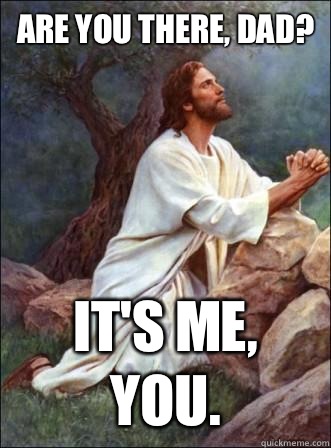
Finally, in the Gospel, we read of Jesus' last words to the disciples before the Ascension.  He reminds them that all power in heaven and earth was given to Him because He is the Word of God (John 1:1).  Jesus instructs them to go make disciples of all nations, baptizing them in the name of the Father, and of the Son, and of the Holy Spirit.  Here we read Jesus dictate to His disciples the persons who constitute God. This is a truth that can never change because it comes from Christ who is the Truth (John 14:6).  God is One in three Divine distinct Persons.  Some atheists tweet around this meme of Christ praying at the Garden of Gethsemane and next to it they write that Christ is praying to Himself and asking Himself to spare Himself from what He is about to go through.  This, of course, shows the ignorance of many atheists who do not understand the Holy Trinity, among many other things.  Our job is not to try to understand this, but to trust this triune God who created us and loves us so much that the second person of this Trinity came, took on flesh, suffered, and died for all of us (John 3:16).  We must trust this God who rescues us from oppression as He did in the Exodus and who sends us His Holy Spirit to remind us of what Christ taught and guide us.  Again, no one can truly understand the Holy Trinity using man's knowledge (1 Corinthians 2:16, Romans 11:34).  We can understand the Holy Trinity with love because God is love (1 John 4:8).  As Catholics, we must go out and evangelize reminding the world of the One God in three Divine Persons.   

God is always with us even in these trying times with the Covid-19 coronavirus pandemic.  It may seem like God abandon us or just simply does not care, but that is not so.  He has been with us since day one and will continue to be with us until the end when the good are weeded from the bad and those who rejected Him will get their wish of existing without feeling connected to God for eternity.        

Readings: The Solemnity of the Most Holy Trinity | USCCB
Please help me expand this work, donate at gofundme.com/sacerdotus


Glory be to the Father,
And to the Son,
And to the Holy Spirit.
As it was in the beginning,
is now, and will be forever. Amen  

Sunday, May 31, 2015

The Holy Trinity - 3 in One

Today we celebrate the Solemnity of the Holy Trinity. We remind ourselves of this important truth of the faith that God is Father, Son, and Holy Spirit.


There are NOT 3 gods, but rather 3 persons who are ONE God or one essence.  For centuries the brightest minds, both within and without the Church have tried to fully comprehend and explain this, but they could not.


God cannot be understood completely by mortals.  Human beings are limited to space, time and matter and can only understand things within the laws and experiences of each.


What human being has experienced infinity in order to define it?  What human being has experienced being all benevolent, all omnipotent, all sapient and all knowing?  There is none.   Human beings are finite creatures with finite minds.
It is important to understand that the Father is not the Son nor the Son the Father.  Moreover, the Father and Son are not the Holy Spirit and vice versa.  Each are distinct Divine persons who are of the same singular Divine substance or essence.


Think of it in this way:  One of western psychology's pioneers and also an atheist, Sigmund Freud believed that human beings have the Super Ego, Ego, and Id which comprises their psyche. Each is distinct but are of one person.  Moreover, human beings have reason, conscience, and self-awareness.  Each are distinct but are of one person. The same with God, but with the difference that each (Father, Son, Holy Spirit) are distinct persons, not attributes of personality as in the aforementioned examples.


There are some sects today who deny the Holy Trinity such as, Jehovah's Witnesses and the Mormons.  Jehovah's Witnesses even went as far as to altering the Gospel of John 1:1 to read ".. the Word was A god..." which was done to support their idea that Jesus is some sort of a lower god or demi-god.  In Genesis 1:26, God says, "Let US make man in OUR image, to be like US."  The words "US" and "OUR" signify plurality of persons.  God describes Himself as a community of persons.


It sounds confusing, but this shows the awesomeness of God.  God will never be completely understood by any creature.  If any creature understands God completely, then God would not be God. He would be a thing in nature that can be understood.


There is a story about Augustine of Hippo who is a Catholic saint and bishop. He is a well-known philosopher and a celebrated champion of Christian thought. 

Anyhow, one day he was trying to figure out God - in particular the idea of Father Son Holy Spirit as one God - he thought and thought and thought wondering how can God be 3 persons in one - how can God be God. Well, while sleeping he had a dream that he was by the shore. He saw a small child digging a hole in the sand. Once dug, the child took a shell and went to the ocean and took water. He brought it back and poured it into the hole. The child then ran back and repeated the same action. Augustine smiled and went to the child and asked the child, "what are you trying to do?" the child answered, "I am trying to put the ocean in this hole." Augustine smiled again thinking the child said something cute. Augustine replied to the child, "The ocean is vast and immense, there is no way you can put it all into this small hole." The child looked at him smiling and replied, "neither can you put all of God in your mind." At that Augustine woke and realized that no one can truly grasp God. It would be like putting the ocean into a small hole dug in the sand on a beach.  This child is said to have been Augustine's guardian angel.

Today's readings introduce the three Divine Persons.  The first person of the Blessed Trinity or The Father is introduced in the first reading. In the first reading, Moses is telling the people of the one true God YHWH (Exodus 8:10, Deuteronomy 4:39,2 Samuel 7:22, 1 Chronicles 17:20). He begins to ask the people if they recall anything so great to ever happen before and if they have ever known of a people who heard the voice of God or any god speaking from fire or venturing out to rescue them from another nation by using tests, signs, wonders and war.  He, of course, is referring to the events of the Exodus (Exodus 13:21-22, Exodus chapters 7-20). Moses was reminding the people then and us today of this one true God. Mankind has formulated all kinds of designations and descriptions for deities trying to define the One God; however, these deities never spoke to them nor went out to rescue them from powerful nations. While these people had the right idea that a Supreme Being exists, they got the name and descriptions wrong.  Only one God has done what Moses described, the God of Abraham, Isaac, Jacob, Moses etc (Exodus 3:6, Acts 3:13).   Moreover, some atheists and skeptics claim the story of Exodus is fiction. However, we have evidence such as the text "Ipuwer Papyrus" which describes the ten plagues that fell over Egypt which Moses reminded us in today's readings.  God is indeed an awesome God. He is faithful and our Father (Deuteronomy 7:9, 1 Corinthians 1:9, Isaiah 64:8, Matthew 6:9).

In the responsorial Psalm, we read of the greatness of God.  His word is upright and trustworthy. God is not a liar (Numbers 23:19, Romans 3:4).  He is fair and just (2 Thessalonians 1:6). The word of God is what brings things to existence (Genesis 1:3).  This "logos" keeps our universe in existence (Hebrews 11:3, Colossians 1:17). We as His children must wait on God and trust in Him for He is our help and our shield (Psalm 91).  His Spirit gives us life, protects us and guides us as we read in the second reading.

The second reading focuses on the third person of the Blessed Trinity whose coming we celebrated last Sunday on Pentecost. This Spirit reminds us that we are sons of God, not slaves (Galatians 3:26). We are able to call God "Abba, Father!"  We are united with the Blessed Trinity in the Spirit, not to be God, but to be sons and daughters of God (1 John 3:2).  This Spirit is our guide and our courage who gives us gifts that allow us to grow in the Holy Trinity and be witnesses to this union of love to the world (John 16:13, 1 Corinthians 12:8-10, Ephesians 4:7-13, Romans 12:3-8).


Finally in the Gospel, we read of Jesus' last words to the disciples before the Ascension.  He reminds them that all power in heaven and earth were given to Him because He is the Word of God (John 1:1).  Jesus instructs them to go make disciples of all nations, baptizing them in the name of the Father, and of the Son, and of the Holy Spirit.  Here we read Jesus dictate to His disciples the persons who constitute God. This is a truth that can never change because it comes from Christ who is the Truth (John 14:6).  God is One in three Divine distinct Persons.  Some atheists tweet around this meme of Christ praying at the Garden of Gethsemane and next to it they write that Christ is praying to Himself and asking Himself to spare Himself from what He is about to go through.  This, of course, shows the ignorance of many atheists who do not understand the Holy Trinity, among many other things.  Our job is not to try to understand this, but to trust this triune God who created us and loves us so much that the second person of this Trinity came, took on flesh, suffered and died for all of us (John 3:16).  We must trust this God who rescues us from oppression as He did in the Exodus and who sends us His Holy Spirit to remind us of what Christ taught and guide us.  Again, no one can truly understand the Holy Trinity using man's knowledge (1 Corinthians 2:16, Romans 11:34).  We can understand the Holy Trinity with love because God is love (1 John 4:8).  As Catholics, we must go out and evangelize reminding the world of the One God in three Divine Persons.        

Readings: http://www.usccb.org/bible/readings/053115.cfm
Please help me expand this work, donate at gofundme.com/sacerdotus


Glory be to the Father,
And to the Son,
And to the Holy Spirit.
As it was in the beginning,
is now, and will be forever. Amen  

Sunday, August 31, 2014

Get Lost in Christ & Find Yourself - 22nd Sunday of Ordinary Time

Today's readings deal with the soul, its relationship with God and carrying the Cross in order to follow Jesus.

In the first reading, we read how Jeremiah says that God "duped" him.  Can you imagine that? God is "duping" or cheating someone?  How is that possible?

Jeremiah is sent to speak on behalf of the Lord and he is mocked, harassed and bullied.  Jeremiah then feels like God cheated him or deceived him.  He feels left out in the cold, so to speak; even to the point of trying to avoid mentioning God, His name or speaking of Him.  However, Jeremiah finds that this is impossible because the desire to continue burns in his heart and he cannot hold it in.

How many times do we feel God has sent us to do something and we think it will be easy but it backfires?  We may try to share our faith to others thinking it will be a smooth "ride" or a calm walk at the park, but instead, it becomes an moment of suffering and disillusionment?  I can speak to this from experience.  Whether preaching on streets, visiting homes and what not, I myself have been met with ridicule and disappointment.  Even on the internet where I have used Twitter, Facebook, and blogs to promote the teachings of Christ in the Catholic Church and have become the topic of mockery and disdain among non-believers and even some believers within and without the Catholic faith.

This is part of the Christian life.  The Christian message will be attractive to some, but will seem disgusting or evil in the eyes of others. You will be made fun of, called outdated, oppressive and immoral just for sharing the faith. Jesus said that His followers will be hated and despised because of Him (Matthew 10:22).  This may not sound fun for the person sharing the faith.  As a matter of fact, sometimes a believer can lose faith.  Like Jeremiah, he or she may feel as if God abandoned him or her.  He or she may not even want to continue sharing the faith, or avoid mentioning God as Jeremiah attempted.  This is called the "dark night of the soul." However, when we are at that point (and it will happen), we will still feel the desire to continue sharing the faith even if it brings pain. We will preach the Word in season and out of season (2 Timothy 4:2).  Ironically, it is during mockery and abuse that the Word gets spread faster.

The responsorial Psalm responds to the first reading from Jeremiah with the response: "My soul is thirsting for you, O Lord my God."  This reminds us that we are constantly desiring God. Even when we feel God has abandoned us or "duped" us, we still seek Him. Everyone is susceptible to this desire, even atheists.  As St. Augustine, whose feast day we celebrated a few days ago said, "Our hearts are restless, until they rest in you." This Psalm encompasses this quote showing how we thirst for God.  Everything God offers is better than life, as the Psalm states. Who else do we have to rely on other than God (John 6:68)?

This ties in with the second reading from Romans where St. Paul tells the Christians of his day and us today that we must offer 'ourselves as living sacrifices' to God in a holy and pleasing manner. This means that we will constantly suffer.  Sacrifices are not pretty.  They are not fun.  These mega-church prosperity preachers who claim God will bring about money and material goods do not understand what Christianity is about.  Sacrifice is necessary. Moreover, St. Paul reminds us not to get used to the world.  We must not fall into the ways of the world but be counter-cultural. We must be ready to give it all up for God's sake even if it pains us greatly.  The will of God must be properly discerned which we know by its characteristics: 1) Must be good. 2) Must be pleasing and perfect.

In the news we sometimes read of our separated brethren in different sects doing things in God's name that bring harm.  They may deny health care to children believing God will heal them, bother snakes, or may protest the funerals of others believing this to be God's will.  In reality, these are not. Denying healthcare to children is not a good.  It is not pleasing nor perfect, so therefore, it cannot be the will of God.  Moreover, protesting the funerals of others is not a good.  It is not pleasing nor perfect, so it too fails to be the will of God.  The will of God is something that is good and brings about good.  It is pleasing and perfect free from human error and nonsense.

Lastly, in the Gospel we read how Jesus tells His disciples that He will suffer greatly, be killed and will rise on the third day.  Peter finds this news unpleasant and tells Jesus "No, God forbid, Lord! No such thing shall ever happen to you." Jesus then responded to him strongly, "Get behind me, Satan!"  Here we see how Satan always tries to present itself as a caring humanist who wants humanity to be comfortable.  This is not how it's supposed to be.  Jesus Himself felt like Jeremiah in the Garden of Gethsemane where His humanity stepped in with its anxieties and fears (Luke 22:42).  We too will feel the same as we grow spiritually.  Remember, the closer you get to God and Heaven, the more "out of place" you will feel on Earth.  

Moreover, Jesus continues with some words which are interesting: "You are thinking not as God does, but as human beings do."  These words are powerful and are important in the philosophical debate on evil existing in a universe where a Good God exists, more commonly called: "The Problem of Evil."  How many times do we see atheists use the Flood of Noah, plagues of Egypt and other events to present God as immoral or evil?  How many times do they inquire how God can let children die of hungry, disease; or how can He let innocent people die in natural disasters or terrorists attacks?  They ask these questions because they think as human beings do and not as God.

God brings good out of anything, even evil events. We see events as evil because are finite creatures trapped in the temporal and spatial. We only see the moment and not the entire film of life, so to speak.  This is why it is difficult to understand why evil exists and why it seems to contradict the existence of a Good God. We must trust God and try to find meaning in the events of life in Him. Rationalizing them with human means will do nothing but bring despair.  Suffering is part of being human and especially Christian.  Jesus had to suffer to redeem the world.  We too have to share in this suffering.

As Jesus said:

“Whoever wishes to come after me must deny himself,
take up his cross, and follow me.
For whoever wishes to save his life will lose it,
but whoever loses his life for my sake will find it.
What profit would there be for one to gain the whole world
and forfeit his life?
Or what can one give in exchange for his life?
For the Son of Man will come with his angels in his Father’s glory,
and then he will repay all according to his conduct.”


Readings:

http://www.usccb.org/bible/readings/083114.cfm

Thursday, August 28, 2014

Real Free Thinkers I

Atheists often say with a glare of arrogance that they are "Free Thinkers." They insinuate that those who believe in God are not "Free Thinkers." Once such example is that of the Hemant Mehta, also known as the "Friendly Atheist." In one video I viewed on youtube, he sarcastically and arrogant says that to those who say to him that they will "pray for him," he replies, "I'll think for you."

The phrase is as corny as it can get. Atheists make it seem as if they are the only ones that "think." In reality, everyone thinks. Just because someone does not share your views or opinions does not make them less of a thinker than you. The phrase "free thinker" really is debatable as I demonstrated in this post http://www.sacerdotus.com/2014/04/atheists-are-not-free-thinkers.html.  If you watch the "Friendly Atheist's" videos and/or read his blog postings, you can tell he is not well read.  He is far from a "free thinker."

Nevertheless, there have been great free thinkers in history.  Today we in the Catholic Church celebrate one.  He converted to Catholicism, became and bishop and is one of the greatest "Fathers" of the Church. He is also spoken of greatly in philosophy, psychology, history, and even science courses.  His name is St. Augustine of Hippo.  You can read more about him in this post: http://www.sacerdotus.com/2013/08/st-augustine-of-hippo.html

Augustine of Hippo was a true free thinker. His thinking, studies and the prayers of his mother St. Monica led him to realize that the Christian God is the one and only God.  Other gods were just man's attempt to define the one and only God. Augustine didn't rely on arguments of the day in regards to God and faith.  He came to the conclusion by himself. Uniting himself to the one and only God, or the "Logos," allowed him to grow even more in wisdom.  He helped expound upon and formulate with great articulation and reason, many of the Church's doctrines.

Unlike today's atheists who rely on outdated irrational arguments from the 17th and 18th centuries, Augustine thought freely. He applied the Hellenistic philosophies which were in circulation at the time and improved on them with his own thoughts and ideas nourished by the grace and wisdom of God. Atheists of today have difficulty pushing their ideas due to the fact that they are indefensible. The many self proclaimed "rationalists" go about the social networking world posting all kinds of lies and distortions in order to make atheism attractive. These pettifoggers go about using mordant statements meant to bait theists into discussions that seem fruitless.  They get caught in their own circular argumentation.

This is not free thinking. It is merely a bloviating form of discourse that engages nothing but the atheist's ego and inner intellectual insecurity.  Augustine was a true free thinker. He thought outside of the box, so to speak. This is what a true free thinker does. He/she does not regurgitate the codswallop rhetoric of thinkers before him/her.    

Saturday, December 28, 2013

Holy Innocents

Today is the feast day of the Holy Innocents.

The Holy Innocents were the infants massacred by order of Herod after he learned that a rival king (Christ) was born.  These children were martyred before even Christ began His public ministry.


A sermon ascribed to St. Augustine reads:

"Today, beloved brethren, we are celebrating the birthday of those children, who, as the Gospel tells us, were slain by the cruel king Herod. Let the world rejoice with great gladness, because she is the fecund parent of this great and powerful army of heavenly soldiers. The heathen foe could never have benefited these little ones by his goodwill as much as he did by his hatred.
 This day's holy festival shows that in proportion as his wickedness abounded towards these blessed little ones, so was the grace of blessedness poured forth upon them. Blessed art thou, O Bethlehem in the land of Judah; in thee was perpetuated the wicked crime of Herod the king; his massacre of these children: and therefore hast thou been found worthy to offer to God in one offering a white-robed multitude of innocent children.
Most fittingly do we keep the festival of their birthday, for their birth from this world into life eternal is more blessed than that from their mothers' wombs. They attained unto life eternal and joined the ranks of the blessed before they had tasted life here on earth.
The precious death of other martyrs deserves praise for its testimony--those who have fought a good fight and finished their course; but death gave glory to these Innocents at the opening of their life, by closing it immediately. Herod in his wickedness snatched these sucklings from their mothers' breasts; rightly are they called the flower of martyrdom, for they sprang up in the midst of the winter of unbelief, as the first opening buds of the Church, and were nipped by the frost of persecution." 
(Sermon 220; 1 on the Innocents) 

The Gospel of Matthew is the only source we have of this account for now.  Perhaps archaeologists may discover new sources in the future.  The account is recorded in Matthew 2:16-18. Herod after being visited by the wise men learned of the Christ child. He pretended to be interested in giving adulation to the child, but instead had cruel intentions.  He ordered that all male children ages two and younger be killed.

The number of children killed is up to speculation.  Greek liturgies claim it was 14,000 boys while others claim it was 144,000 which is a reference to Revelation 14:3.  However, modern biblical scholars believe it was in the dozens because Bethlehem is a small town and it would be logical that the amount would be less than 50.

Jewish historian Flavius Josephus does not mention this story in detail like the Gospel of Matthew does, but he does mention other atrocities committed by Herod.  Since children did not enjoy the full legal stature of person-hood then, it is possible that any crimes against them were not mentioned in detail for this very reason. Josephus usually recorded events surrounding more renown figures.

In any event, Matthew wrote his Gospel in a way that speaks directly to those of the old covenant, or the Jews. He makes a great effort to link Jesus to the prophecies of the Old Testament so that Jews reading the text can see that Christ was indeed the promised Messiah. Matthew's writing on the Holy Innocent shows the fulfillment of the prophecy found in Jeremiah 31:15.

Moreover, in Exodus 1:22 we read of a massacre of Hebrew babies which precedes the introduction of Moses in Exodus 2 where we are told that he is hidden in a basket from the massacre and rescued by the Pharaoh's daughter. This is interesting because Moses was a liberator. He by the grace of God liberated the Hebrews from Egypt.  Similarly, Christ the Son of God is a liberator; not from political figures or social injustices, but from sin. Christ, like Moses was spared of infanticide.

Ironically, in today's modern world many 'holy innocents' are being killed via abortion. It makes me wonder if history will repeat itself.  Is the liberator coming again after the slaughter of the innocents via abortion?    


Saturday, December 14, 2013

Question on Agnoeticism


A young man recently posted a question on my Facebook regarding Hypostasis.  Here is the question and my reply:

Question:
I've got a question in Christology I have not satisfactorily answered. It is what is written in Mark 13:32, "32 "But of that day or that hour no one knows, not even the angels in heaven, nor the Son, but only the Father."...I know about Acts 1:7 ("7 He said to them, "It is not for you to know times or seasons which the Father has fixed by his own authority.")...but this would not answer, WHY WOULD JESUS WOULD APPARENTLY LIE OF NOT KNOWING WHEN THE JUDGEMENT DAY IS.....I would not subscribe to the idea that he doesnt really know being God, of the Parousia. And the reasoning, that only his human nature speaks when he said that denial, is impossible, because of the reality of the Hypostasis. Can anybody help me or can Sacerdotus reply ? Thanks in advance...and i would appreciate if the reply is made via my email.


Sacerdotus replies:

Thanks for your question.  

Your question is important and I'm glad you posed it.  Agnoeticism was a heresy that was condemned by many Popes.

“If anyone says that the one Jesus Christ who is both true Son of God and true Son of man did not know the future or the day of the Last Judgment and that he could know only as much as the divinity, dwelling in him as in another, revealed to him, anathema sit.” - Pope Vigilius, Constitutum I of 14 May 553

It states that Jesus did not know the hour of His second coming, basically making Jesus to look like a demi-god or merely human and not divine.

Jesus has three kinds of knowledge:

  • Beatific knowledge 
  • Infused knowledge 
  • Acquired knowledge.  
Beatific knowledge is when a human being knows things via inspiration or Divine guidance. Infused knowledge is when God directly puts knowledge in our minds without us doing anything by means of learning on our own.  Acquired knowledge is what we all rely on which is learning via the senses. Christ knows of His second coming via the first two, but not acquired knowledge because no human can know/learn of this on his/her own.


St. Augustine comments:
“According to the form of God everything that the Father has belongs to the Son for All things that are mine are yours, and yours are mine. According to the form of a slave, however, his teaching is not his own but of the One who sent him. Hence of that day or hour no one knows, neither the angels in heaven, nor the Son, but the Father only. He is ignorant of this in the special sense of making others ignorant. He did not know it in their presence in such a way as to be prepared to reveal it to them at that time.”

So to sum it up: Christ knew, always knew, but it was not the time for him to reveal it.  Think of it as a sort of mental reservation, not absence of knowledge.

Wednesday, August 28, 2013

St. Augustine of Hippo

St. Augustine of Hippo was born in Tagaste on November 13, 354.  He came from a humble and modest family; his father was Patricius who was a curiale of the government and was a pagan. His mother was Monica, who was a Catholic and responsible for bringing both Augustine and his father to the faith later on.

Augustine was a very bright student.  His father wanted him to study forensics after he noticed that his son excelled in academia. While studying, he fell into many temptations at Carthage. Like today, there were many vices that existed that attracted naive youth.  St. Augustine was not immune to this and fell into these vices.  He adopted Manichaeism and then Neo-Platonism before converting to Catholicism in 387.

St. Augustine is the father of Western Philosophy and helped formulate many of Christianity's tenets of faith making him a 'Church Father.' He was an intellectual and gifted scholar who put his talents to use in promoting the faith. He was a professor of rhetoric and enjoyed teaching.

His mother, Monica who is a canonized saint prayed for her son Augustine for all of her life.  After reading St. Anthony of the Desert's story, Augustine began his conversion to Catholicism.  He also read St. Paul's Epistle to the Romans which also aided him in his conversion.  Augustine was baptized by St. Ambrose alongside with his son Adeodatus in 387 at Milan during the Easter Vigil. A year later he would write, "On the Holiness of the Catholic Church."

Afterwards, Monica passed on as well as his son. Augustine sold off his family's property and gave the monies to the poor only retaining his home which he converted into a monastery.  He felt called to the priesthood and in 391 was ordained a priest in hippo which is now Algeria.  Four years later he would be made Bishop of Hippo.  He remained at that post until his death in 430.

He wrote many works which are in use today in both secular and religious institutions. Augustine is a model for all those seeking the truth.  He went from Christianity, to Paganism and even skepticism; and perhaps a mild form of atheism.  He found faith not only via Monica's prayers, but also via reason and academia.

The youth of today can learn from Augustine.  Today's youth often go to college with faith and graduate as atheists or are indifferent to religious beliefs and morality.  They often fall into many vices while in college as well.  Augustine faced the same things. He was met with vices and strange ideas pontificated in schools during his time.  Students today face the same threats to their minds and bodies.

Moreover, Augustine is a model for atheists who sincerely want to seek the truth regarding God and faith.  He did not resort to childishness or bullying tactics like the so-called "new atheism" of today which seeks to hide behind irrational beliefs instead of opening their cognitive abilities to process God and faith in a rational manner.

May St. Augustine pray for us and all those seeking faith.      


Sacerdotus TV LIveStream

Labels

Catholic Church (1641) Jesus (765) God (754) Bible (621) Atheism (400) Jesus Christ (378) Pope Francis (347) Liturgy of the Word (324) Apologetics (301) Atheist (280) Science (239) Christianity (203) Theology (152) LGBT (148) Liturgy (139) Blessed Virgin Mary (129) Prayer (99) Abortion (97) Gay (95) Philosophy (93) Pope Benedict XVI (93) Traditionalists (84) Rosa Rubicondior (82) Vatican (77) Physics (74) Psychology (74) Christmas (64) New York City (62) Holy Eucharist (61) Christian (60) President Obama (59) Protestant (53) Vatican II (51) Health (49) Biology (48) Politics (47) Gospel (46) Women (44) Racism (40) Supreme Court (35) Baseball (34) Death (34) Pope John Paul II (33) Illegal Immigrants (32) NYPD (32) priests (32) Priesthood (29) Morality (28) Space (28) Astrophysics (27) Eucharist (27) Jewish (27) Religious Freedom (27) Donald Trump (25) Evangelization (25) Christ (22) Evil (22) First Amendment (21) Pro Abortion (19) Child Abuse (17) Divine Mercy (17) Marriage (17) Pedophilia (17) Pro Choice (17) Easter Sunday (16) Holy Trinity (16) Police (16) Pentecostals (15) Sacraments (15) Angels (14) Autism (14) Gender Theory (14) Poverty (13) September 11 (13) Blog (12) CUNY (12) Cognitive Psychology (12) Muslims (12) academia (12) Hispanics (11) Pope Paul VI (11) Evangelicals (10) Massimo Pigliucci (10) Personhood (10) Evidence (9) Hell (9) Podcast (9) Barack Obama (8) Big Bang Theory (8) Human Rights (8) Humanism (8) Condoms (7) David Viviano (7) Death penalty (7) Eastern Orthodox (7) Ellif_dwulfe (7) NY Yankees (7) Spiritual Life (7) Encyclical (6) Gender Dysphoria Disorder (6) Babies (5) Baby Jesus (5) Catholic Bloggers (5) Cyber Bullying (5) Donations (5) Pope Pius XII (5) The Walking Dead (5) Ephebophilia (4) Plenary Indulgence (4) Pluto (4) Pope John XXIII (4) Founding Fathers (3) Dan Arel (2) Freeatheism (2) Oxfam (2) Penn Jillette (2) Pew Research Center (2) Cursillo (1) Dan Savage (1) Divine Providence (1) Fear The Walking Dead (1) Pentecostales (1)