Showing posts with label God The Father. Show all posts

Sunday, May 31, 2026

Reflection for the Solemnity of the Most Holy Trinity


A Reflection on the Readings for the Solemnity of the Most Holy Trinity – May 31, 2026

On this Solemnity, the Church invites us to contemplate the central mystery of our faith: one God in three Persons—Father, Son, and Holy Spirit. The readings do not offer a philosophical treatise but reveal the living God who encounters humanity in history, calls us into relationship, and draws us into the divine life of love.


 First Reading: Exodus 34:4b-6, 8-9

Moses ascends Mount Sinai with new stone tablets after the people’s infidelity with the golden calf. The Lord descends in a cloud and proclaims His name: “The LORD, the LORD, a merciful and gracious God, slow to anger and rich in kindness and fidelity.” Moses bows in worship and pleads for the stiff-necked people: “Pardon our wickedness and sins, and receive us as your own.”

This passage shows God’s self-revelation as compassionate and faithful despite human failure. The Trinity is not yet explicit, but we glimpse the Father’s merciful heart—the same God who will send His Son and pour out His Spirit. God’s “kindness and fidelity” (hesed and emet) foreshadow the fullness of divine love revealed in Christ.


 Responsorial Psalm: Daniel 3:52-56

The canticle blesses God in His temple, on His throne, and in the depths of creation: “Glory and praise for ever!” It echoes the Trinitarian doxology, praising the one God who transcends yet permeates all things. The psalm calls us to join creation in adoring the mystery we cannot fully comprehend but can only worship.


 Second Reading: 2 Corinthians 13:11-13

Paul concludes his letter with practical exhortations—rejoice, mend your ways, live in peace—followed by this profound Trinitarian blessing: “The grace of the Lord Jesus Christ and the love of God and the fellowship of the Holy Spirit be with all of you.”

This is one of the clearest New Testament formulations of the Trinity. Grace flows from Christ, love from the Father, and communion (koinonia) from the Spirit. The Trinity is not abstract; it is the source of our unity, peace, and missionary life. Paul’s words remind us that Trinitarian faith shapes Christian community: we are called to reflect the mutual love and harmony of the divine Persons.


 Gospel: John 3:16-18

“For God so loved the world that he gave his only Son, so that everyone who believes in him might not perish but might have eternal life.” This beloved verse reveals the Father’s initiative in salvation. The Son is “given” (incarnation and crucifixion) not for condemnation but for the world’s rescue. Belief in the Son brings life; rejection brings self-condemnation.


The Mystery of the Most Holy Trinity

The Trinity is the central mystery of the Christian faith: there is only one God who exists eternally in three distinct Persons — the Father, the Son, and the Holy Spirit. Each Person is fully and completely God, yet they are not three gods but one. They share the same divine substance (or essence) while remaining distinct in their relations: the Father begets the Son, the Son is begotten of the Father, and the Holy Spirit proceeds from the Father and the Son (in the Western tradition). This is not a mathematical puzzle or a contradiction, but a profound revelation of God as eternal, self-giving Love in perfect communion.

The doctrine was clarified over centuries through Scripture (e.g., the baptism of Jesus in Matthew 3:16-17, the Great Commission in Matthew 28:19) and the early Church councils, especially Nicaea (325) and Constantinople (381). The Trinity reveals that God is not solitary or distant but relational at His very core. As the Catechism of the Catholic Church teaches, it is “the source of all the other mysteries of faith” and “the light that enlightens them.”


 St. Augustine and the Child on the Beach

A well-known medieval legend illustrates both the depth of this mystery and the limits of human reason. While working on his monumental treatise De Trinitate (On the Trinity), St. Augustine of Hippo (354–430) was walking along the seashore, deeply pondering how God could be both One and Three. He saw a young boy (sometimes described as using a seashell or bucket) running back and forth from the ocean to a small hole he had dug in the sand. The child was scooping seawater and pouring it into the hole.

Amused and curious, Augustine asked what he was doing. The boy replied that he was trying to empty the entire ocean into the little hole. Augustine gently pointed out the impossibility: “You could never fit this great, magnificent ocean into that tiny hole!” The child then turned to him and said, “And you could never possibly understand [or fit] the Holy Trinity [into your small mind].” With that, the boy vanished — many traditions say he was an angel, or even the Christ Child Himself, sent to teach humility.

This story, which first appears in medieval sources long after Augustine’s death, does not mean we should stop reflecting on the Trinity. Rather, it reminds us that while we can know something true about God through revelation and reason (as Augustine himself did in his profound writings), we can never fully comprehend the infinite with our finite minds. The legend encourages both intellectual pursuit and humble adoration.

In the end, the Trinity is not a problem to be solved but a mystery to be lived — encountered in prayer, experienced in the Church’s sacraments, and reflected in our call to love one another as God loves within Himself. Glory to the Father, and to the Son, and to the Holy Spirit.

Here the Trinity emerges dynamically: the Father sends the Son out of love, and the Spirit will complete this work (though not named explicitly in these verses). John 3:16 invites personal response—faith in the Son opens us to the life of the Trinity.


 Personal and Communal Reflection

These readings invite awe before a God who is not solitary but eternally relational—Father, Son, and Holy Spirit in perfect communion. The Trinity is the pattern of all reality: love poured out, received, and returned.


- In our prayer: We are drawn into this divine dialogue through the liturgy, especially the Eucharist, where we encounter the Trinity most intimately.

- In our life: Like Moses, we intercede for a “stiff-necked” world. Like Paul’s community, we mend divisions and greet one another with holy peace. Like the believer in John’s Gospel, we entrust ourselves to the Son who reveals the Father’s love.

- In mission: The Trinity sends us forth. Just as the Father sends the Son, and the Spirit is sent by both, the Church is missionary by nature—called to make disciples of all nations in the name of the Trinity (cf. Matthew 28:19).


On this feast, may we echo the psalmist’s praise and open our hearts to the God who is Love itself. May the grace of Christ, the love of the Father, and the fellowship of the Holy Spirit transform us into living images of the Trinity—united, merciful, and life-giving to the world. Glory be to the Father, and to the Son, and to the Holy Spirit, as it was in the beginning, is now, and ever shall be, world without end. Amen.

Saturday, May 23, 2026

Debunking Common Myths About the Holy Spirit: Restoring Biblical Truth

Debunking Common Myths About the Holy Spirit: Restoring Biblical Truth

The Holy Spirit is the third Person of the Blessed Trinity—fully God, co-equal with the Father and the Son, and actively at work in creation, redemption, and the life of the Church. Yet misconceptions persist, often stemming from incomplete readings of Scripture, cultural influences, or historical heresies like Arianism, Modalism, or modern charismatic excesses. This post addresses eight prevalent myths, drawing from Sacred Scripture and orthodox Christian theology (primarily Catholic and broader Trinitarian perspectives). Understanding the Holy Spirit correctly deepens our relationship with God and guards against error.


Myth 1: The Holy Spirit Is Not a Person but an Impersonal Force

Many, influenced by groups like the Jehovah’s Witnesses or pop culture (“the Force” from Star Wars), view the Holy Spirit as God’s energy or power rather than a divine Person. Scripture refutes this decisively. The Holy Spirit possesses intellect, will, and emotions—hallmarks of personhood. He speaks (Acts 13:2), grieves (Ephesians 4:30), can be lied to (Acts 5:3-4), teaches (John 14:26), and intercedes (Romans 8:26-27). Jesus refers to Him with personal pronouns: “He will guide you into all truth” (John 16:13). At baptism, the Spirit descends as a dove while the Father speaks and the Son is present (Matthew 3:16-17), showing distinct personhood within unity. Calling the Spirit “it” diminishes the personal relational God revealed in the Trinity.


Myth 2: The Holy Spirit Was Not Present or Active in the Old Testament

This myth arises from overlooking the continuity between Testaments. The Spirit is active from the very beginning: “The Spirit of God was hovering over the waters” at creation (Genesis 1:2). He gives life (Psalm 104:29-30), empowers judges and leaders (Judges 3:10 on Othniel; 1 Samuel 16:13 on David), inspires prophets (2 Peter 1:21; Ezekiel 2:2), and fills artisans (Exodus 31:3). David prays, “Do not take your Holy Spirit from me” (Psalm 51:11). The New Testament fulfills rather than introduces the Spirit’s work; Pentecost pours Him out universally (Acts 2; Joel 2:28-29). The same Spirit who moved in the Old Testament now indwells believers permanently through Christ.


Myth 3: The Gift of Tongues Was Speaking Gibberish or Ecstatic Nonsense

Pentecost reveals tongues (glossolalia) as real, intelligible human languages: “We hear them declaring the wonders of God in our own tongues!” (Acts 2:11). Devout Jews from many nations understood the apostles without interpreters. The Greek glossa means languages, not unintelligible sounds. In 1 Corinthians 14, Paul regulates tongues for edification, requiring interpretation in public worship and preferring prophecy for clarity. Modern “prayer languages” or gibberish often resemble pagan ecstatic utterances Paul contrasted with true gifts. The authentic gift served evangelism and confirmed the Gospel’s spread, not private emotional experience detached from understanding.  Some Catholic charistmatic groups do engage in this "charism," but it is simply out of emotional expression. 


Myth 4: The Holy Spirit Is Not Equal to the Father or the Son

Arian-like views subordinate the Spirit. Yet Scripture affirms equality. The Great Commission baptizes “in the name [singular] of the Father and of the Son and of the Holy Spirit” (Matthew 28:19). The Spirit is called God (Acts 5:3-4), possesses divine attributes (omniscience: 1 Corinthians 2:10-11; omnipresence: Psalm 139:7), and performs divine works (creation, regeneration, sanctification). The Nicene Creed declares Him “the Lord and Giver of Life, who with the Father and the Son is adored and glorified.” Denying equality fractures the Trinity and undermines salvation, as only God can divinize us.


Myth 5: The Holy Spirit Proceeds Only from the Father

This touches the Filioque controversy dividing East and West. The original Nicene-Constantinopolitan Creed states the Spirit “proceeds from the Father.” Western churches added “and the Son” (Filioque), reflecting Scripture: Jesus breathes the Spirit on the apostles (John 20:22), sends Him (John 15:26; 16:7), and the Spirit is “of the Son” (Galatians 4:6; Romans 8:9). The addition safeguards the Son’s full divinity without denying the Father as source. Both traditions affirm the Spirit’s divinity; the debate concerns relational emphasis, not core orthodoxy. Catholics uphold the Filioque as legitimate development.


Myth 6: The Holy Spirit Is Merely a Metaphor for the Love Between the Father and the Son

St. Augustine influentially described the Spirit as the bond of love uniting Father and Son. This is beautiful but incomplete if taken as reductionist. The Spirit is a distinct Person, not an abstract relation. He has personal actions (convicting the world of sin, John 16:8; guiding, John 16:13) and is worshiped as God. Metaphors illuminate but never exhaust the mystery of the Trinity. Reducing the Spirit to love alone echoes Modalism, blurring distinct persons.


Myth 7: The Holy Spirit Is a Woman or Feminine Being

Hebrew ruach (spirit) is grammatically feminine, and some early Syriac or Gnostic texts used maternal imagery. However, God is pure Spirit without biological sex (John 4:24). Jesus consistently uses masculine pronouns for the Paraclete (“He,” John 14-16). The Trinity reveals relational names: Father, Son, Holy Spirit—not gendered in a creaturely sense. Attributing femininity risks pagan goddess syncretism or distorting the revealed economy of salvation. Women and men both image the full Godhead (Genesis 1:27).


Other Common Myths


- Myth: The Holy Spirit’s main role is spectacular miracles or emotional highs. Reality: He primarily convicts, sanctifies, produces fruit (Galatians 5:22-23), and conforms us to Christ in ordinary life. Miracles serve the Kingdom, not spectacle.

- Myth: Only “super Christians” receive the Spirit. All baptized believers receive Him (Romans 8:9; 1 Corinthians 12:13).

- Myth: The Spirit contradicts or supersedes Scripture. He inspired it (2 Timothy 3:16) and never contradicts His own Word.


Conclusion

The Holy Spirit is not an afterthought or vague power but the living God who empowers, comforts, and transforms. Correcting these myths invites deeper surrender: “Be filled with the Spirit” (Ephesians 5:18). Let us honor Him as Person, equal, and gift—invoking Him daily in prayer, sacraments, and mission.


References  

- Catechism of the Catholic Church, paragraphs 683-741.  

- Holy Bible (various translations: NIV, ESV, NABRE).  

- Thomas Nelson Bibles: “The Holy Spirit in the Old Testament.”  

- ChurchPop: “5 Myths About the Holy Spirit.”  

- GotQuestions.org and BibleProject resources on tongues and Trinity.  

- Augustine, De Trinitate; historical creeds (Nicene).  


Sunday, May 12, 2024

Reflection for the 7th Sunday of Easter: Let Them Be One

As the Seventh Sunday of Easter approaches, Catholics around the world prepare to delve into the profound spiritual themes presented in the liturgy for Year B. This day offers a moment of reflection on the readings that speak to the heart of Christian faith and the journey towards unity with God.

The first reading from Acts 1:15-17, 20A, 20C-26, presents the narrative of the Apostles choosing Matthias to replace Judas, emphasizing the importance of apostolic witness and continuity in the Church's mission. It is a reminder of the Church's resilience and the unbroken line of witness that stretches back to the very beginnings of the Christian faith.

The Responsorial Psalm, Psalm 103, is a poetic expression of praise, acknowledging God's mercy and the vastness of His love. It is a call to remember the kindnesses of the Lord, who rules over all from His throne in heaven.

The second reading from 1 John 4:11-16 invites the faithful to reflect on the profound love of God and the call to love one another deeply. This mutual love confirms God's presence among us and perfects His love through our actions. It is a powerful message that challenges believers to live out the commandment of love in tangible ways.

The Gospel reading from John 17:11B-19 is particularly moving, as it recounts Jesus' prayer for His disciples. He prays not for their removal from the world but for their protection from evil. Jesus asks for their sanctification and unity, mirroring the unity between Him and the Father. This passage invites the faithful to consider their own place in the world and their commitment to living out the Gospel values.

The themes for this Sunday revolve around leadership, divine love, and Jesus' prayer for His disciples. They call for a commitment to reject evil and live lives of service, to be united with God in love, and to be consecrated to the Good News.

In reflection, the Seventh Sunday of Easter invites the faithful to ponder their relationship with God and their role in the world. It is a time to ask oneself: How does my life reflect my belonging to God? How do I embody the love that God has for me in my interactions with others? And how do I contribute to the unity and sanctification that Jesus prayed for?

The greatest scandal in Christianity may be the sex abuse scandal perpetuated by Catholics, Protestants and Eastern Non-Catholic Christians, however, in reality the biggest scandal is disunity. Yes, sex abuse is evil and sinful. It is a crime, but in context to today's Gospel we must concede that the greatest scandal is disuinty. Jesus wanted His followers to be ONE. To be sanctified in Truth. Unfortunately we do not see this today. Since the Great Schism and Protestant Reformation, there have been huge divides in Christianity that are inexcusable.  We have many rites in the Eastern Church who refuse to be united to Peter or the Papacy. They argue against the Holy Spirit proceding the Father and the Son and other details of doctrine that have been established since the first century. Then we have the numerous Protestant sects and denonminations each claiming to be the "One True Church" presenting different and contradicting doctrines. In many instances, they subtract main doctrines and Scripture in order to push their propaganda. 

This is not what Jesus Christ the Lord who is One with the Father and the Holy Spirit wanted.  He wanted unity!  One Lord, One Faith, One Baptism as Scripture says!  Because of this disunity we have seen a rise in secularism and other idealogies that defy reason. How can Christianity be true if it is divide? How can we trust a faith that has different groups with different views and interpretations of the Bible?  How can we believe groups that claim to be Christian why demoting Christ into "a god," editing John 1:1 to say Jesus is "a god" and that Jesus is Michael the archangel?  Jesus is the Truth. The Church is ONE body. She cannot be different bodies attached to each other.  We must work hard to be united again. The Eastern Christians who broke from Rome must reevaluate history, particular Church history and see that the Pope has always been Peter and the Vicar of Christ.  They must study theology deeply and see that the teachings of the Roman Church have never changed and are consistent since the first century.  Protestants must learn history and see that a rogue priest named Martin Luther fathered their divorce from the Catholic Church. They must learn that their sects were founded by European White men and that their views contradict the Bible and what Christians taught and believed since the first century.  

As we approach this sacred time, let us embrace the messages of the readings and carry them into our daily lives, striving to live in the image of the love and unity that Christ has shown us. May this reflection serve as a guide for personal meditation and communal worship, leading to a deeper understanding and a stronger commitment to our faith journey.

Sunday, May 30, 2021

The Holy Trinity - Three in One

 Today we celebrate the Solemnity of the Holy Trinity. We remind ourselves of this important truth of the faith that God is Father, Son, and Holy Spirit.

There are NOT 3 gods, but rather 3 persons who are ONE God or one essence.  For centuries the brightest minds, both within and without the Church have tried to fully comprehend and explain this, but they could not.

God cannot be understood completely by mortals.  Human beings are limited to space, time, and matter and can only understand things within the laws and experiences of each.

What human being has experienced infinity in order to define it?  What human being has experienced being all benevolent, all omnipotent, all sapient, and all-knowing?  There is none.   Human beings are finite creatures with finite minds.
It is important to understand that the Father is not the Son nor the Son the Father.  Moreover, the Father and Son are not the Holy Spirit and vice versa.  Each is distinct Divine persons who are of the same singular Divine substance or essence.

Think of it in this way:  One of western psychology's pioneers and also an atheist, Sigmund Freud believed that human beings have the Super Ego, Ego, and Id which comprises their psyche. Each is distinct but is of one person.  Moreover, human beings have a reason, conscience, and self-awareness.  Each is distinct but is of one person. The same with God, but with the difference that each (Father, Son, Holy Spirit) are distinct persons, not attributes of personality as in the aforementioned examples.

There are some sects today that deny the Holy Trinity such as, Jehovah's Witnesses and the Mormons.  Jehovah's Witnesses even went as far as to altering the Gospel of John 1:1 to read ".. the Word was A god..." which was done to support their idea that Jesus is some sort of a lower god or demi-god.  In Genesis 1:26, God says, "Let US make man in OUR image, to be like US."  The words "US" and "OUR" signify a plurality of persons.  God describes Himself as a community of persons.

It sounds confusing, but this shows the awesomeness of God.  God will never be completely understood by any creature.  If any creature understands God completely, then God would not be God. He would be a thing in nature that can be understood.

There is a story about Augustine of Hippo who is a Catholic saint and bishop. He is a well-known philosopher and a celebrated champion of Christian thought. 

Anyhow, one day he was trying to figure out God - in particular the idea of Father Son Holy Spirit as one God - he thought and thought and thought wondering how can God be 3 persons in one - how can God be God. Well, while sleeping he had a dream that he was by the shore. He saw a small child digging a hole in the sand. Once dug, the child took a shell and went to the ocean and took water. He brought it back and poured it into the hole. The child then ran back and repeated the same action. Augustine smiled and went to the child and asked the child, "what are you trying to do?" the child answered, "I am trying to put the ocean in this hole." Augustine smiled again thinking the child said something cute. Augustine replied to the child, "The ocean is vast and immense, there is no way you can put it all into this small hole." The child looked at him smiling and replied, "neither can you put all of God in your mind." At that Augustine woke and realized that no one can truly grasp God. It would be like putting the ocean into a small hole dug in the sand on a beach.  This child is said to have been Augustine's guardian angel.

Today's readings introduce the three Divine Persons.  The first person of the Blessed Trinity or The Father is introduced in the first reading. In the first reading, Moses is telling the people of the one true God YHWH (Exodus 8:10, Deuteronomy 4:39,2 Samuel 7:22, 1 Chronicles 17:20). He begins to ask the people if they recall anything so great to ever happen before and if they have ever known of a people who heard the voice of God or any god speaking from fire or venturing out to rescue them from another nation by using tests, signs, wonders, and war.  He, of course, is referring to the events of the Exodus (Exodus 13:21-22, Exodus chapters 7-20). Moses was reminding the people then and us today of this one true God. Mankind has formulated all kinds of designations and descriptions for deities trying to define the One God; however, these deities never spoke to them nor went out to rescue them from powerful nations. While these people had the right idea that a Supreme Being exists, they got the name and descriptions wrong.  Only one God has done what Moses described, the God of Abraham, Isaac, Jacob, Moses, etc (Exodus 3:6, Acts 3:13).   Moreover, some atheists and skeptics claim the story of Exodus is fiction. However, we have evidence such as the text "Ipuwer Papyrus" which describes the ten plagues that fell over Egypt which Moses reminded us of in today's readings.  God is indeed an awesome God. He is faithful and our Father (Deuteronomy 7:9, 1 Corinthians 1:9, Isaiah 64:8, Matthew 6:9).

In the responsorial Psalm, we read of the greatness of God.  His word is upright and trustworthy. God is not a liar (Numbers 23:19, Romans 3:4).  He is fair and just (2 Thessalonians 1:6). The word of God is what brings things to existence (Genesis 1:3).  This "logos" keeps our universe in existence (Hebrews 11:3, Colossians 1:17). We as His children must wait on God and trust in Him for He is our help and our shield (Psalm 91).  His Spirit gives us life, protects us, and guides us as we read in the second reading.

The second reading focuses on the third person of the Blessed Trinity whose coming we celebrated last Sunday on Pentecost. This Spirit reminds us that we are sons of God, not slaves (Galatians 3:26). We are able to call God "Abba, Father!"  We are united with the Blessed Trinity in the Spirit, not to be God, but to be sons and daughters of God (1 John 3:2).  This Spirit is our guide and our courage who gives us gifts that allow us to grow in the Holy Trinity and be witnesses to this union of love to the world (John 16:13, 1 Corinthians 12:8-10, Ephesians 4:7-13, Romans 12:3-8).

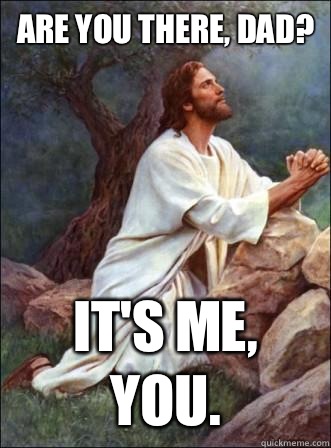
Finally, in the Gospel, we read of Jesus' last words to the disciples before the Ascension.  He reminds them that all power in heaven and earth was given to Him because He is the Word of God (John 1:1).  Jesus instructs them to go make disciples of all nations, baptizing them in the name of the Father, and of the Son, and of the Holy Spirit.  Here we read Jesus dictate to His disciples the persons who constitute God. This is a truth that can never change because it comes from Christ who is the Truth (John 14:6).  God is One in three Divine distinct Persons.  Some atheists tweet around this meme of Christ praying at the Garden of Gethsemane and next to it they write that Christ is praying to Himself and asking Himself to spare Himself from what He is about to go through.  This, of course, shows the ignorance of many atheists who do not understand the Holy Trinity, among many other things.  Our job is not to try to understand this, but to trust this triune God who created us and loves us so much that the second person of this Trinity came, took on flesh, suffered, and died for all of us (John 3:16).  We must trust this God who rescues us from oppression as He did in the Exodus and who sends us His Holy Spirit to remind us of what Christ taught and guide us.  Again, no one can truly understand the Holy Trinity using man's knowledge (1 Corinthians 2:16, Romans 11:34).  We can understand the Holy Trinity with love because God is love (1 John 4:8).  As Catholics, we must go out and evangelize reminding the world of the One God in three Divine Persons.   

God is always with us even in these trying times with the Covid-19 coronavirus pandemic.  It may seem like God abandon us or just simply does not care, but that is not so.  He has been with us since day one and will continue to be with us until the end when the good are weeded from the bad and those who rejected Him will get their wish of existing without feeling connected to God for eternity.        

Readings: The Solemnity of the Most Holy Trinity | USCCB
Please help me expand this work, donate at gofundme.com/sacerdotus


Glory be to the Father,
And to the Son,
And to the Holy Spirit.
As it was in the beginning,
is now, and will be forever. Amen  

Sunday, May 31, 2015

The Holy Trinity - 3 in One

Today we celebrate the Solemnity of the Holy Trinity. We remind ourselves of this important truth of the faith that God is Father, Son, and Holy Spirit.


There are NOT 3 gods, but rather 3 persons who are ONE God or one essence.  For centuries the brightest minds, both within and without the Church have tried to fully comprehend and explain this, but they could not.


God cannot be understood completely by mortals.  Human beings are limited to space, time and matter and can only understand things within the laws and experiences of each.


What human being has experienced infinity in order to define it?  What human being has experienced being all benevolent, all omnipotent, all sapient and all knowing?  There is none.   Human beings are finite creatures with finite minds.
It is important to understand that the Father is not the Son nor the Son the Father.  Moreover, the Father and Son are not the Holy Spirit and vice versa.  Each are distinct Divine persons who are of the same singular Divine substance or essence.


Think of it in this way:  One of western psychology's pioneers and also an atheist, Sigmund Freud believed that human beings have the Super Ego, Ego, and Id which comprises their psyche. Each is distinct but are of one person.  Moreover, human beings have reason, conscience, and self-awareness.  Each are distinct but are of one person. The same with God, but with the difference that each (Father, Son, Holy Spirit) are distinct persons, not attributes of personality as in the aforementioned examples.


There are some sects today who deny the Holy Trinity such as, Jehovah's Witnesses and the Mormons.  Jehovah's Witnesses even went as far as to altering the Gospel of John 1:1 to read ".. the Word was A god..." which was done to support their idea that Jesus is some sort of a lower god or demi-god.  In Genesis 1:26, God says, "Let US make man in OUR image, to be like US."  The words "US" and "OUR" signify plurality of persons.  God describes Himself as a community of persons.


It sounds confusing, but this shows the awesomeness of God.  God will never be completely understood by any creature.  If any creature understands God completely, then God would not be God. He would be a thing in nature that can be understood.


There is a story about Augustine of Hippo who is a Catholic saint and bishop. He is a well-known philosopher and a celebrated champion of Christian thought. 

Anyhow, one day he was trying to figure out God - in particular the idea of Father Son Holy Spirit as one God - he thought and thought and thought wondering how can God be 3 persons in one - how can God be God. Well, while sleeping he had a dream that he was by the shore. He saw a small child digging a hole in the sand. Once dug, the child took a shell and went to the ocean and took water. He brought it back and poured it into the hole. The child then ran back and repeated the same action. Augustine smiled and went to the child and asked the child, "what are you trying to do?" the child answered, "I am trying to put the ocean in this hole." Augustine smiled again thinking the child said something cute. Augustine replied to the child, "The ocean is vast and immense, there is no way you can put it all into this small hole." The child looked at him smiling and replied, "neither can you put all of God in your mind." At that Augustine woke and realized that no one can truly grasp God. It would be like putting the ocean into a small hole dug in the sand on a beach.  This child is said to have been Augustine's guardian angel.

Today's readings introduce the three Divine Persons.  The first person of the Blessed Trinity or The Father is introduced in the first reading. In the first reading, Moses is telling the people of the one true God YHWH (Exodus 8:10, Deuteronomy 4:39,2 Samuel 7:22, 1 Chronicles 17:20). He begins to ask the people if they recall anything so great to ever happen before and if they have ever known of a people who heard the voice of God or any god speaking from fire or venturing out to rescue them from another nation by using tests, signs, wonders and war.  He, of course, is referring to the events of the Exodus (Exodus 13:21-22, Exodus chapters 7-20). Moses was reminding the people then and us today of this one true God. Mankind has formulated all kinds of designations and descriptions for deities trying to define the One God; however, these deities never spoke to them nor went out to rescue them from powerful nations. While these people had the right idea that a Supreme Being exists, they got the name and descriptions wrong.  Only one God has done what Moses described, the God of Abraham, Isaac, Jacob, Moses etc (Exodus 3:6, Acts 3:13).   Moreover, some atheists and skeptics claim the story of Exodus is fiction. However, we have evidence such as the text "Ipuwer Papyrus" which describes the ten plagues that fell over Egypt which Moses reminded us in today's readings.  God is indeed an awesome God. He is faithful and our Father (Deuteronomy 7:9, 1 Corinthians 1:9, Isaiah 64:8, Matthew 6:9).

In the responsorial Psalm, we read of the greatness of God.  His word is upright and trustworthy. God is not a liar (Numbers 23:19, Romans 3:4).  He is fair and just (2 Thessalonians 1:6). The word of God is what brings things to existence (Genesis 1:3).  This "logos" keeps our universe in existence (Hebrews 11:3, Colossians 1:17). We as His children must wait on God and trust in Him for He is our help and our shield (Psalm 91).  His Spirit gives us life, protects us and guides us as we read in the second reading.

The second reading focuses on the third person of the Blessed Trinity whose coming we celebrated last Sunday on Pentecost. This Spirit reminds us that we are sons of God, not slaves (Galatians 3:26). We are able to call God "Abba, Father!"  We are united with the Blessed Trinity in the Spirit, not to be God, but to be sons and daughters of God (1 John 3:2).  This Spirit is our guide and our courage who gives us gifts that allow us to grow in the Holy Trinity and be witnesses to this union of love to the world (John 16:13, 1 Corinthians 12:8-10, Ephesians 4:7-13, Romans 12:3-8).


Finally in the Gospel, we read of Jesus' last words to the disciples before the Ascension.  He reminds them that all power in heaven and earth were given to Him because He is the Word of God (John 1:1).  Jesus instructs them to go make disciples of all nations, baptizing them in the name of the Father, and of the Son, and of the Holy Spirit.  Here we read Jesus dictate to His disciples the persons who constitute God. This is a truth that can never change because it comes from Christ who is the Truth (John 14:6).  God is One in three Divine distinct Persons.  Some atheists tweet around this meme of Christ praying at the Garden of Gethsemane and next to it they write that Christ is praying to Himself and asking Himself to spare Himself from what He is about to go through.  This, of course, shows the ignorance of many atheists who do not understand the Holy Trinity, among many other things.  Our job is not to try to understand this, but to trust this triune God who created us and loves us so much that the second person of this Trinity came, took on flesh, suffered and died for all of us (John 3:16).  We must trust this God who rescues us from oppression as He did in the Exodus and who sends us His Holy Spirit to remind us of what Christ taught and guide us.  Again, no one can truly understand the Holy Trinity using man's knowledge (1 Corinthians 2:16, Romans 11:34).  We can understand the Holy Trinity with love because God is love (1 John 4:8).  As Catholics, we must go out and evangelize reminding the world of the One God in three Divine Persons.        

Readings: http://www.usccb.org/bible/readings/053115.cfm
Please help me expand this work, donate at gofundme.com/sacerdotus


Glory be to the Father,
And to the Son,
And to the Holy Spirit.
As it was in the beginning,
is now, and will be forever. Amen  

Sacerdotus TV LIveStream

Labels

Catholic Church (1576) Jesus (734) God (722) Bible (600) Atheism (399) Jesus Christ (378) Pope Francis (343) Liturgy of the Word (315) Atheist (279) Apologetics (265) Science (236) Christianity (198) LGBT (148) Theology (143) Liturgy (137) Blessed Virgin Mary (122) Abortion (97) Prayer (96) Gay (95) Philosophy (92) Pope Benedict XVI (91) Rosa Rubicondior (82) Traditionalists (81) Psychology (74) Vatican (74) Physics (73) Christmas (64) Holy Eucharist (61) Christian (60) New York City (59) President Obama (59) Protestant (53) Vatican II (50) Biology (48) Health (47) Politics (46) Women (44) Gospel (42) Racism (40) Supreme Court (35) Baseball (34) Illegal Immigrants (32) Pope John Paul II (32) priests (32) Death (31) NYPD (31) Priesthood (28) Space (28) Astrophysics (27) Jewish (27) Morality (27) Religious Freedom (27) Eucharist (26) Evangelization (25) Donald Trump (24) Christ (22) Evil (22) First Amendment (21) Pro Abortion (19) Child Abuse (17) Divine Mercy (17) Marriage (17) Pedophilia (17) Pro Choice (17) Easter Sunday (16) Holy Trinity (16) Police (16) Autism (14) Gender Theory (14) Pentecostals (14) Sacraments (14) Angels (13) Poverty (13) Blog (12) CUNY (12) Cognitive Psychology (12) Muslims (12) September 11 (12) academia (12) Hispanics (11) Pope Paul VI (11) Massimo Pigliucci (10) Evidence (9) Hell (9) Personhood (9) Podcast (9) Barack Obama (8) Big Bang Theory (8) Evangelicals (8) Human Rights (8) Humanism (8) Condoms (7) David Viviano (7) Eastern Orthodox (7) Ellif_dwulfe (7) NY Yankees (7) Spiritual Life (7) Encyclical (6) Gender Dysphoria Disorder (6) Babies (5) Baby Jesus (5) Catholic Bloggers (5) Cyber Bullying (5) Donations (5) Pope Pius XII (5) The Walking Dead (5) Ephebophilia (4) Plenary Indulgence (4) Pluto (4) Pope John XXIII (4) Death penalty (3) Founding Fathers (3) Dan Arel (2) Freeatheism (2) Oxfam (2) Penn Jillette (2) Pew Research Center (2) Cursillo (1) Dan Savage (1) Divine Providence (1) Fear The Walking Dead (1) Pentecostales (1)